
For SaaS companies, growth is not simply about generating more leads. It is about reaching the right buyers, creating demand for the product, building trust throughout the buying journey, and converting interest into qualified pipeline.
This is where a demand generation agency can make a difference. Instead of focusing exclusively on form submissions or contact lists, it helps connect marketing activities with how potential customers discover, evaluate, and purchase software.
For US based SaaS companies selling to other businesses, this often means combining audience research, content, targeted campaigns, marketing automation, and performance measurement.
Here are five activities to look for when evaluating one of the SaaS demand generation agencies.
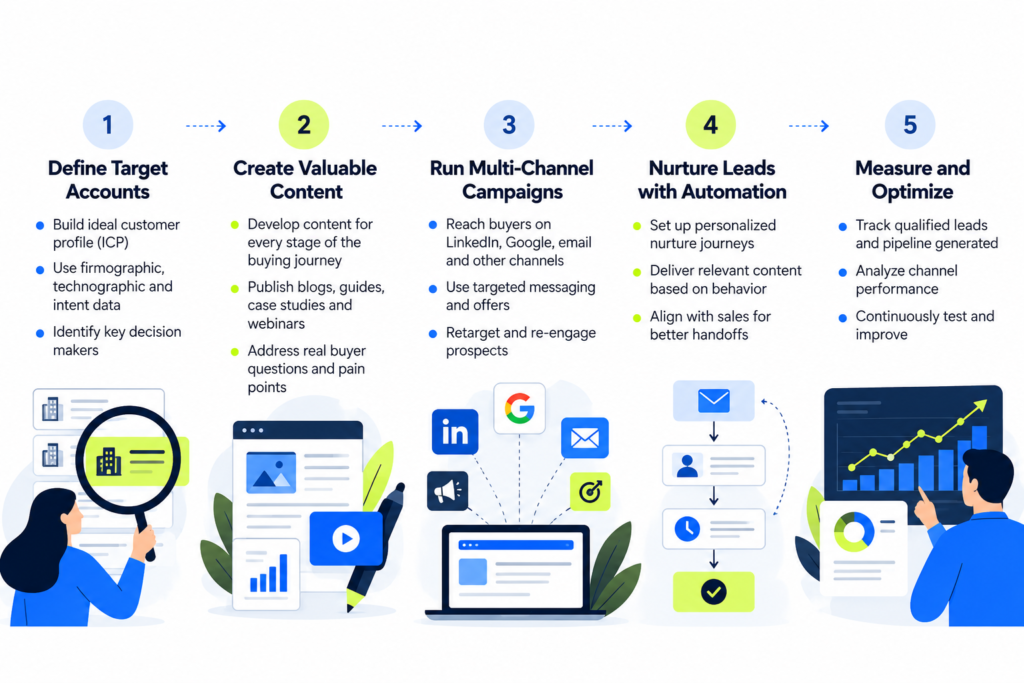
1. Define the Ideal Customer Profile and Build Targeted Audiences
Demand generation starts with understanding who is most likely to buy your product and why they would choose it.
Without a clearly defined ideal customer profile (ICP), SaaS companies risk spending their budgets reaching businesses that have little need for their solution, lack purchasing authority, or cannot afford the product.
A demand generation agency helps identify the characteristics of high-value accounts, including industry, company size, annual revenue, technology stack, business challenges, and buying triggers.
For example, a SaaS company selling workflow automation software to mid-market businesses might target US companies with 100 to 1,000 employees that rely on manual processes across multiple departments. Its messaging can then address operational inefficiencies rather than promote automation features in isolation.
Typical activities include:
- Defining ICPs and buyer personas based on business goals and customer data.
- Segmenting audiences by industry, company size, role, and buying intent.
- Identifying relevant accounts and decision-makers.
- Mapping customer pain points to specific product use cases.
This groundwork helps a B2B demand generation service focus its resources on accounts with a stronger likelihood of becoming customers.
2. Create Content That Builds Awareness and Buyer Confidence
B2B SaaS buyers rarely purchase software after seeing a single advertisement. They research problems, compare alternatives, assess risks, and look for evidence that a solution will deliver business value.
Content helps your company participate in that research process.
A demand generation marketing agency develops content around the questions buyers ask at different stages of their journey. The objective is to educate potential customers while establishing your company as a credible option.
Depending on the product and audience, this can include:
- SEO focused blog articles that address specific customer problems.
- Comparison pages and solution pages for buyers evaluating alternatives.
- Case studies that demonstrate measurable customer outcomes.
- Webinars, guides, and reports that explain complex challenges.
- LinkedIn content that builds visibility among relevant decision-makers.
Consider a cybersecurity SaaS company targeting US healthcare providers. Articles about compliance challenges, security risks, and practical prevention strategies can attract relevant audiences before they actively request a product demonstration.
Content should not exist simply to increase website traffic. It should help buyers understand their problem, evaluate potential solutions, and progress toward a purchasing decision.
3. Run Targeted Campaigns Across Multiple Channels
Publishing content alone rarely creates enough demand to support consistent SaaS growth. Your ideal buyers need multiple opportunities to discover your brand, engage with your ideas, and consider your solution.
A SaaS demand generation agency plans campaigns across the channels most relevant to your audience and sales cycle.
Common activities include:
- LinkedIn advertising: Reaching founders, executives, and functional decision-makers by job title, industry, and company attributes.
- Paid search: Capturing buyers actively searching for software solutions or researching specific business problems.
- Email marketing: Nurturing opted-in prospects with relevant insights, product education, and useful follow-up.
- Organic social media: Building brand familiarity and sharing expertise with prospective customers.
- Retargeting: Reengaging website visitors who have shown interest but have not yet taken the next step.
For example, a US-based SaaS company selling financial reporting software might use paid search to reach buyers actively researching reporting tools. LinkedIn campaigns could introduce its solution to finance leaders, while educational content helps prospects understand the cost of inefficient reporting.
The channels should work together rather than operate as disconnected campaigns. The right mix depends on your audience, average contract value, sales cycle, available budget, and existing performance data.
A good agency also tests messaging, audiences, and offers instead of assuming that every channel will deliver results immediately.
4. Build Lead Nurturing and Marketing Automation Workflows
Generating initial interest is only one part of the demand generation process. Many B2B SaaS prospects need weeks or months to evaluate a product, secure internal approval, and make a purchasing decision.
Without a structured nurturing process, interested prospects can disengage before they are ready to speak with sales.
A demand generation agency helps design workflows that deliver relevant information based on a prospect’s interests, behavior, and buying stage.
These activities may include:
- Developing email sequences around specific customer problems or use cases.
- Segmenting contacts based on engagement and product interest.
- Creating follow-up journeys after webinars, content downloads, or product inquiries.
- Aligning lead qualification criteria with the sales team.
- Connecting marketing automation with the CRM to improve visibility into prospect activity.
For instance, someone who downloads a guide about SaaS security requirements may need educational content before receiving a product demonstration offer. A prospect who requests pricing, however, may need faster sales follow-up.
This distinction matters because sending the same message to every contact can weaken engagement and waste sales resources.
Effective nurturing helps prospects make informed decisions while giving sales teams better context for their conversations.
5. Measure Pipeline Contribution and Optimize Performance
The final activity is understanding whether demand generation is contributing to business growth.
Lead volume, website traffic, and email engagement provide useful information, but they do not tell the complete story. SaaS companies also need to understand whether marketing is generating qualified opportunities and supporting revenue.
A demand generation agency should establish measurement frameworks that connect campaign performance with the sales pipeline.
Important metrics include:
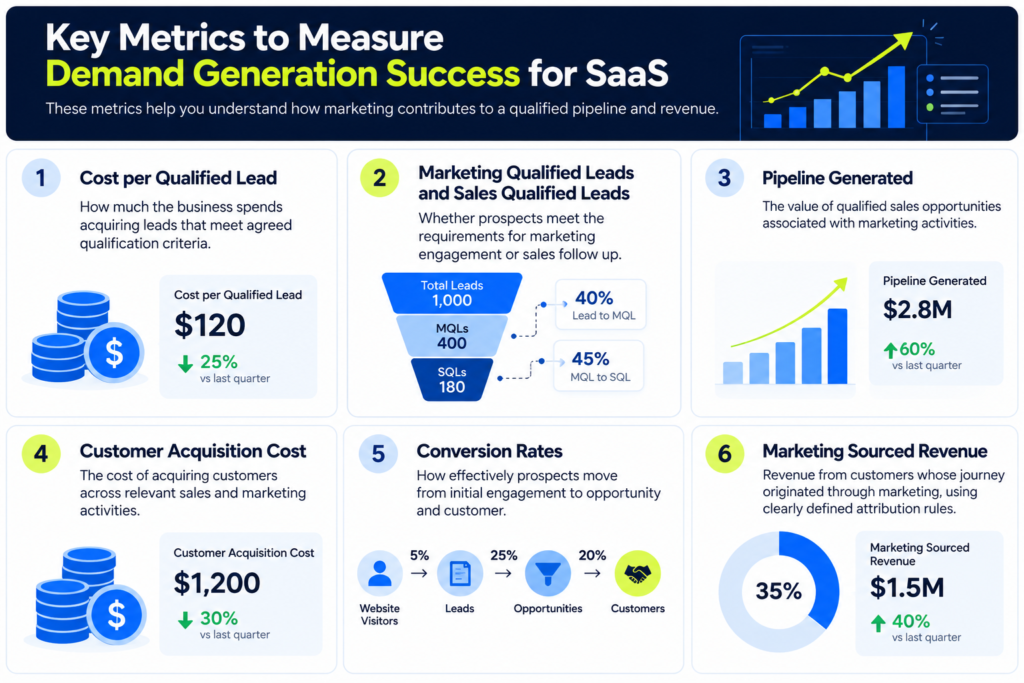
- Cost per qualified lead: How much the business spends acquiring leads that meet agreed qualification criteria.
- Marketing qualified leads and sales qualified leads: Whether prospects meet the requirements for marketing engagement or sales follow up.
- Pipeline generated: The value of qualified sales opportunities associated with marketing activities.
- Customer acquisition cost: The cost of acquiring customers across relevant sales and marketing activities.
- Conversion rates: How effectively prospects move from initial engagement to opportunity and customer.
- Marketing-sourced revenue: Revenue from customers whose journey originated through marketing, using clearly defined attribution rules.
For example, a campaign generating 500 leads may appear successful until the sales team discovers that few prospects match the ICP. Another campaign generating 80 leads could deliver substantially more qualified opportunities.
This is why reporting should go beyond surface-level engagement.
A capable agency reviews performance regularly, identifies bottlenecks, tests improvements, and reallocates resources toward activities that demonstrate stronger commercial potential. It should also distinguish between marketing-sourced pipeline and marketing-influenced pipeline to avoid overstating its contribution.
How to Choose the Right Demand Generation Agency for Your SaaS Business
When comparing demand generation agencies in the USA, look beyond promises of more leads or lower acquisition costs.
Evaluate whether the agency understands your SaaS business model, target market, sales cycle, and revenue objectives. Ask how it defines qualified pipeline, measures campaign effectiveness, and works with your internal sales team.
The best fit is an agency that can explain why it recommends particular activities, how those activities connect, and which metrics will determine success.
You should also establish realistic expectations. Demand generation is not an instant fix for weak positioning, poor product-market fit, or an ineffective sales process. Results depend on several factors, including market demand, competition, pricing, execution, and sales follow-up.
For growing SaaS businesses, the right B2B demand generation services provide a structured approach to building awareness, engaging relevant buyers, and creating opportunities that sales teams can pursue.
Final Thoughts
A demand generation agency should do more than launch campaigns. Its role is to help your SaaS company build a connected system for reaching the right audience and converting interest into measurable business opportunities.
The five core activities are:
- Defining your ideal customer profile and target accounts.
- Creating content that educates buyers and builds trust.
- Running targeted campaigns across relevant channels.
- Nurturing prospects through marketing automation.
- Measuring pipeline contribution and optimizing performance.
If you are evaluating a demand generation agency for your SaaS company in the USA, start by identifying where your current growth process is breaking down. You may need stronger audience targeting, better conversion paths, more consistent nurturing, or clearer pipeline measurement.
The goal is not simply to generate more leads. It is to build a repeatable path from buyer interest to revenue.
Looking to Build a More Predictable SaaS Pipeline?
If your marketing generates activity but not enough qualified sales opportunities, it may be time to rethink your demand generation strategy.
At ACRevScalers, we help B2B and SaaS companies connect growth strategy, demand generation, and marketing execution to measurable revenue outcomes.
Contact us to learn more about our demand generation services to identify opportunities to improve your pipeline and build a more focused path to growth.
Related News