

When Should B2B Companies Bring in Senior Marketing Leadership with a Fractional CMO?
There is a point in the growth of many B2B companies when marketing becomes too important for the founder to manage personally, but hiring a full time Chief Marketing Officer still feels premature.
The company may already have marketers, salespeople, agencies and specialist partners. There may be SEO activity, content production, paid advertising, LinkedIn campaigns and a CRM containing hundreds of contacts. Yet the founder still has to decide what the marketing team should prioritize, which channels deserve investment and why the pipeline is not growing as expected.
This is often a leadership problem rather than an execution problem.
A fractional CMO can provide the senior marketing leadership required at this stage without requiring the company to make a full-time executive hire. More importantly, the right fractional CMO does not simply manage marketing activities. They create the strategic direction that allows those activities to work together.
What Does a Fractional CMO Actually Do?
A fractional CMO is an experienced marketing executive who works with a company on a part-time basis and takes responsibility for strategic marketing leadership.
The role can include positioning, messaging, go-to-market strategy, demand generation, marketing planning, channel selection, marketing and sales alignment, team leadership, agency management and performance measurement.
The scope depends on the company’s situation.
A startup may need help defining its market, positioning, and initial demand generation strategy. A growing B2B SaaS company may need someone to connect an existing marketing team with revenue objectives. A technology company may already have several agencies and specialists but need an experienced leader to determine whether those investments are actually producing qualified pipeline.
The common thread is strategic accountability.
A fractional CMO should be able to look across the marketing function and determine what needs to happen, what does not need to happen and where resources are being wasted.
Why Companies Hire a Fractional CMO
One of the most common reasons companies hire a fractional CMO is that the founder has become the de facto head of marketing.
This often happens gradually. The founder approves messaging, chooses agencies, reviews campaign reports, participates in content decisions, discusses lead quality with sales and decides whether the company should invest in another channel.
At an early stage, that involvement can be useful. As the business grows, however, it becomes a significant drain on the founder’s time.
The company may also reach a point where hiring individual specialists no longer solves the problem. More people are executing, but nobody is responsible for determining whether all that execution adds up to a coherent growth strategy.
This is where fractional CMO services can provide value.
Instead of adding another person to manage one channel, the company gets senior leadership capable of looking at the entire marketing system and setting priorities based on business objectives.
Marketing Activity Is Not the Same as Marketing Strategy
A company can be extremely busy and still have a weak marketing strategy.
There may be weekly social posts, monthly newsletters, SEO articles, paid campaigns and outbound sequences running simultaneously. Each activity can produce its own report and performance metrics.
But the founder ultimately needs to know whether those activities are contributing to revenue.
This is one reason revenue growth consulting and fractional CMO leadership increasingly overlap. Marketing decisions need to be connected to the company’s commercial objectives rather than evaluated independently.
Suppose a company wants to increase revenue substantially over the next year. The marketing leader should be able to work backwards from that objective and determine how much qualified pipeline is required, which customer segments should be prioritised, how much demand needs to be created and where the current growth system is falling short.
That may lead to more content.
It may lead to a stronger outbound strategy, investment in performance marketing, the conclusion that the company should not spend more on acquisition until its positioning and conversion process are fixed.
The strategy should determine the activity, not the other way around.
The Role of Demand Generation
For B2B companies, demand generation is particularly important because buyers often spend considerable time researching a problem before engaging with sales.
A company therefore needs more than a mechanism for collecting contact details. It needs to create awareness, establish credibility and give potential buyers a reason to consider the company before they are ready to have a sales conversation.
A fractional CMO can determine how content, thought leadership, search, outbound, events, partnerships, paid media and other activities should contribute to that process.
This also helps prevent a common mistake: confusing lead generation with demand generation.
A campaign that produces 1,000 contacts may look impressive in a marketing report, but those contacts are not necessarily valuable prospects. What matters is whether the company is reaching the right audience and creating genuine commercial interest.
For B2B companies, quality and relevance often matter more than raw lead volume.
Where Growth Marketing and Performance Marketing Fit
Growth marketing is most effective when it is connected to a clearly defined business objective.
A fractional CMO can determine where experimentation is useful and which parts of the customer journey deserve attention. That might include testing positioning, improving conversion rates, developing new acquisition channels or finding better ways to nurture existing demand.
Performance marketing has a similar requirement for strategic oversight.
Paid advertising can produce rapid traffic and lead volume, but increasing media spend does not automatically create profitable growth. Audience selection, messaging, offers, landing pages, conversion rates, sales follow-up, and customer acquisition economics all influence the final outcome.
A fractional CMO does not need to personally manage every advertising campaign. Their responsibility is to ensure that performance marketing is being used for the right commercial purpose and that the results are evaluated within the broader revenue system.
Why a Fractional Marketing Team Can Complement a Fractional CMO
Strategic leadership is only useful when the company can execute the resulting strategy.
This is where a fractional marketing team can complement a fractional CMO.
Instead of hiring every specialist internally, a company can access expertise across areas such as content, SEO, outreach, automation, web development, design and other marketing functions as required.
The benefit is not simply lower headcount.
It is coordination.
A fractional CMO can establish the strategy and priorities while specialists execute the work. This gives the company access to senior thinking and practical execution without forcing the founder to manage several independent vendors.
It also avoids the problem of asking a single generalist marketer to simultaneously handle strategy, content, SEO, paid acquisition, analytics and demand generation.
Fractional CMO vs Digital Marketing Agency
A digital marketing agency and a fractional CMO can serve very different purposes.
A digital marketing agency typically provides execution across one or more marketing disciplines. It may manage SEO, paid search, social media, content, email or other digital activities.
A fractional CMO provides leadership over the marketing function.
This distinction becomes important when a company already has agencies but lacks strategic direction. Hiring another agency may simply add another supplier to the existing collection of marketing partners.
A fractional CMO can instead evaluate the existing structure, determine which activities are worth continuing and establish how the various functions should work together.
In some cases, the fractional CMO may recommend using a digital marketing agency. In another situation, they may recommend bringing certain capabilities in house or using specialist partners only where they add genuine value.
The answer should come from the company’s growth requirements.
B2B Fractional CMO: Why B2B Companies Need Strategic Leadership
A B2B fractional CMO needs to understand how business buyers make decisions. B2B purchases can involve several stakeholders, longer sales cycles, technical evaluations, procurement processes and significant financial commitments. Marketing therefore has to do more than create awareness.
It needs to help the buyer understand the problem, evaluate alternatives, assess risk and build confidence in the company.
This makes positioning particularly important. If a technology company cannot clearly explain who it serves, what problem it solves and why its solution is meaningfully different, increasing marketing activity will not necessarily solve the problem. The fractional CMO needs to identify these strategic issues and make sure marketing is addressing them before asking the team to scale acquisition.
When Should You Hire a Fractional CMO?
There is no universal revenue number at which every company should hire fractional CMO support.
The more useful question is whether the company has reached a level of marketing complexity that requires senior leadership.
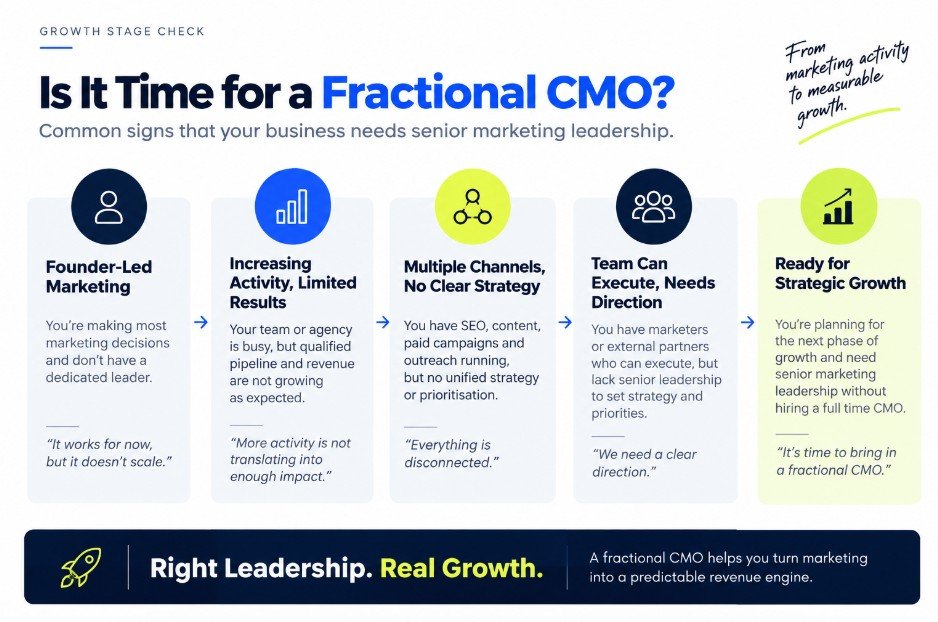
Some common indicators include:
- The founder is still making most major marketing decisions.
- Marketing activity is increasing but qualified pipeline is not growing at the same rate.
- The company has several specialists or agencies but no clear marketing leader.
- Sales and marketing disagree about lead quality or pipeline responsibility.
- The company’s positioning has become unclear as it has entered new markets.
- Marketing expenditure is increasing without clear visibility into commercial returns.
- The company is preparing for a significant growth phase but does not yet need a full-time CMO.
- The internal marketing team can execute but needs stronger strategic direction.
When several of these conditions exist, the company may not need more marketing resources. It may need better marketing leadership.
Fractional CMO for Startups
A fractional CMO for startups can be particularly valuable when the company has validated its product but has not yet established a repeatable approach to acquiring customers.
Startups have limited resources, which makes strategic prioritisation critical. Investing simultaneously in SEO, paid advertising, social media, outbound and content without knowing which activities can realistically produce demand can quickly consume a limited budget.
A fractional CMO can help determine the company’s ideal customer profile, positioning, go-to-market strategy, demand generation priorities, and marketing measurement framework.
As the startup grows, the role can evolve. Early work may focus heavily on positioning and market strategy. Later, the focus can move toward building the marketing team, managing demand generation, improving pipeline, and preparing the company for a larger internal marketing organisation.
How to Choose the Right Fractional CMO Agency
When evaluating a fractional CMO agency, founders should look beyond the number of services listed on the website.
The important questions are strategic.
Can the partner explain how it diagnoses a company’s growth problem? Can it connect marketing activity with pipeline? Can it challenge an assumption when the evidence suggests that a particular channel is not appropriate? Can it work with an existing team rather than replacing everything? Can it take responsibility for the overall marketing direction?
These questions are more useful than simply asking whether the partner provides SEO, paid media, content or social media.
A company may describe itself as a revenue growth marketing agency and still operate primarily as a collection of channel specialists. What matters is whether the partner actually understands how those channels contribute to the company’s commercial objectives.
Why ACRevScalers Is a Strong Choice for B2B Founders
ACRevScalers is positioned specifically around the needs of B2B and SaaS founders who need stronger marketing and revenue leadership. Its approach is built around diagnosing the gap between marketing activity and business objectives before determining what the company actually needs.
That diagnosis-first approach is central to the company’s positioning. ACRevScalers does not treat SEO, outbound, paid media or other channels as separate products that every company automatically needs. The channel follows the diagnosis and the growth requirement.
This is particularly relevant for founders who have already worked with agencies or internal marketers but remain dissatisfied with the connection between marketing activity and revenue.
ACRevScalers works with B2B and SaaS companies, including technology businesses, and is designed for post revenue companies where founders need strategic leadership without necessarily building a large internal marketing organisation immediately.
The model can also combine senior strategic leadership with specialist execution. Its growth team model includes strategic leadership supported by specialists across content, outreach, automation, web development, video, and design when required.
This creates a useful middle ground between hiring a full-time CMO and managing several independent marketing vendors.
For founders looking to hire a fractional CMO, particularly B2B and SaaS founders who need both strategy and execution, ACRevScalers offers a model built around diagnosis, strategic direction and measurable growth rather than simply increasing marketing activity.
You can learn more about its fractional CMO services here:
ACRevScalers Fractional CMO Services
Frequently Asked Questions About Fractional CMO Services
What is a fractional CMO?
A fractional CMO is an experienced marketing executive who provides senior marketing leadership on a part time basis. The role can include marketing strategy, positioning, demand generation, team leadership, channel prioritisation and marketing and sales alignment.
What is the difference between a fractional CMO and a marketing agency?
A marketing agency generally focuses on executing specific marketing activities, while a fractional CMO provides strategic leadership across the marketing function. A fractional CMO can also manage or coordinate existing agencies and specialist partners.
When should a company hire a fractional CMO?
A company should consider hiring a fractional CMO when it needs senior marketing leadership but is not yet ready for a full-time CMO. Common signals include inconsistent pipeline, disconnected marketing activities, unclear positioning, poor marketing and sales alignment or a founder who remains responsible for most marketing decisions.
What does a fractional CMO do for a B2B company?
A B2B fractional CMO can develop marketing strategy, refine positioning, establish demand generation priorities, align marketing with sales, direct internal teams and external partners, and connect marketing performance with pipeline and revenue objectives.
Can a fractional CMO work with an existing marketing team?
Yes. In fact, this is often one of the strongest applications of fractional CMO leadership. The CMO can establish priorities and strategic direction while existing marketers and specialists focus on execution.
What is the difference between a fractional CMO and a fractional marketing team?
A fractional CMO provides senior strategic leadership. A fractional marketing team provides execution capabilities across multiple marketing disciplines. The two models can work together when a company needs both strategic direction and specialist execution.
Is a fractional CMO suitable for startups?
Yes. A fractional CMO for startups can help establish positioning, go-to-market strategy, demand generation, and marketing priorities before the company commits to building a larger internal marketing organisation.
Can a fractional CMO help with revenue growth consulting?
Yes. Fractional CMO leadership can complement revenue growth consulting by connecting marketing strategy with pipeline, customer acquisition and revenue objectives. The key is ensuring that marketing decisions are made in the context of the company’s broader commercial strategy.
Should a company hire a fractional CMO or a digital marketing agency?
The answer depends on the problem. A digital marketing agency can be appropriate when the company already has a clear strategy and needs specialist execution. A fractional CMO is more appropriate when the company needs senior marketing leadership, strategic direction, and coordination across multiple activities.
Conclusion: Senior Marketing Leadership Without the Full-Time Commitment
The decision to bring in a fractional CMO should not be based simply on the desire to reduce the cost of hiring a full time executive. The more important consideration is whether the business needs senior marketing leadership at its current stage of growth.
For many B2B companies, the problem is not that there are too few marketing activities. It is that those activities are not connected by a clear strategy or owned by someone accountable for the overall outcome.
The key takeaways are:
- A fractional CMO provides strategic marketing leadership when a company has outgrown founder led marketing but may not yet need a full time CMO.
- Fractional CMO services can cover strategy, positioning, demand generation, growth marketing, team leadership and marketing and sales alignment, depending on the company’s requirements.
- B2B companies need marketing leadership that understands the complexity of business buying, rather than simply applying individual channel tactics.
- A fractional marketing team can complement a fractional CMO by providing specialist execution without requiring the company to build every capability internally.
- Performance marketing and demand generation work better when they are guided by a broader strategy, rather than being treated as independent acquisition activities.
- Revenue growth consulting can help connect marketing investment with pipeline and commercial objectives, particularly when a company’s marketing activity is not translating into predictable growth.
- A fractional CMO for startups can establish the strategic foundation for growth before the company builds a larger internal marketing function.
- The right fractional CMO agency should diagnose the business before recommending channels or services.
For B2B and SaaS founders who need experienced marketing leadership but are not ready to build a full-time executive function, a fractional CMO can provide the strategic layer needed to turn scattered marketing activity into a more coherent growth system.
ACRevScalers provides this kind of strategic marketing leadership for B2B and SaaS companies, combining diagnosis, strategy, and execution support around the company’s actual growth requirements.

Ashvini Vyas is the founder of ACRevScalers and a B2B growth marketing strategist with nearly two decades of experience building revenue-aligned marketing systems for SaaS, technology, and B2B platforms across Australia, the US, and the UK. Her work spans go-to-market strategy, demand generation, and fractional CMO advisory, with a particular focus on translating complex, technical products into marketing that converts.
Popular News