
Business needs more leads. The marketing team wants to put more effort into SEO and web marketing. Paid ads are running, but the leads are not converting. Someone suggests investing more heavily in demand generation. Meanwhile, sales is complaining about lead quality, and the founder is left trying to work out why marketing looks busy but the pipeline still feels unpredictable.
This is a familiar problem in B2B.
The answer is rarely as simple as adding another channel. Sometimes the business genuinely needs more demand. In other cases, the real issue is poor positioning, weak qualifications, low conversion or a disconnect between marketing and sales.
That is why digital marketing case studies are useful when they are analysed properly. The value is not in copying another company’s SEO strategy or advertising campaign. It is in understanding what problem the business was trying to solve, what changed, which numbers moved and why the change improved the commercial outcome.
For B2B SaaS and technology companies, the strongest campaigns usually have one thing in common: the channels are working as part of a revenue system rather than as isolated marketing activities.
What do successful digital marketing case studies reveal about B2B growth?
Successful campaigns are usually built around a clear business problem rather than a particular marketing channel. The company identifies where growth is getting stuck, determines what is causing the bottleneck and then uses the right combination of positioning, demand generation, acquisition, conversion and sales to address it.
Consider a B2B SaaS company generating around $250,000 in qualified pipeline each month. Traffic is increasing, the paid campaigns are producing leads and the content team is publishing consistently, yet the company has missed its quarterly pipeline target for two consecutive quarters.
The founder’s first reaction is understandable: the business needs more leads.
The marketing team increases paid acquisition. SEO gets a larger content budget. Outbound activity goes up. Within three months, MQL volume has increased by 40%.
Pipeline has barely moved.
A closer look reveals that the company is attracting too broad an audience. Some campaigns are bringing in smaller businesses that do not fit the product’s pricing model, while high-intent visitors are landing on pages that describe product features rather than the operational problem they are trying to solve.
The issue was never simply lead volume.
The company had a revenue alignment problem.
That distinction is central to ACRevScalers’ own positioning. Its messaging framework is built around diagnosing the gap between marketing activity and the revenue goal before deciding which channel or level of execution is actually required.
Lesson 1: Why does buying more marketing activity often fail to fix a pipeline problem?
More marketing activity cannot compensate for a poorly understood revenue problem. If the business has not identified where qualified buyers are being lost, adding SEO, paid media, outbound or content can simply create more activity around the same underlying constraint.
This is where many founders get caught.
Business needs more leads, so the natural response is to increase lead generation. The website needs more visibility, so the team decides to put more effort into SEO web marketing. Paid ads are not converting, so the advertising budget gets moved around. Sales is not happy with the leads, so someone suggests demand generation.
Each decision sounds reasonable in isolation.
The problem is that nobody has stepped back to ask what is actually happening between the first interaction and closed revenue.
Imagine a B2B technology company spending $30,000 a month across SEO, paid acquisition and outbound. It generates 450 MQLs in a quarter, but only 55 become sales-qualified opportunities. The founder decides the marketing team needs to get the MQL number closer to 600.
Instead, an audit shows that almost half of the leads come from companies outside the ICP. The website attracts significant informational traffic, while the commercial pages receive relatively little attention. Sales also has no agreed definition of what qualifies as an SQL.
Increasing MQL volume would not solve those problems.
A better plan would start with ICP refinement, messaging, qualification criteria and conversion paths. Only after those foundations are clear does it make sense to determine whether the company needs additional SEO, paid acquisition, outbound or another form of demand generation.
This is why the distinction between buying a channel and building a revenue system matters.
ACRevScalers’ messaging framework describes the problem directly: founders can have marketing activity running in every direction while nobody owns whether that activity actually turns into pipeline.
What should founders investigate before adding another marketing channel?
Look at the complete journey from acquisition to opportunity creation. The important questions are whether the right ICP is being reached, whether the positioning is compelling, whether leads are qualified correctly, where prospects drop out and whether sales is converting the opportunities marketing creates.
The answer might genuinely be more demand generation.
It might instead be better SEO targeting, stronger landing pages, improved sales enablement or a clearer GTM strategy.
The point is not to avoid marketing investment.
It is to make sure the investment is aimed at the constraint that is actually limiting growth.
Lesson 2: Will more leads create a bigger problem?
They can, particularly when lead volume increases faster than lead quality. More MQLs only create more commercial value when enough of those prospects fit the ICP, have meaningful buying intent and can progress into qualified opportunities.
Consider a SaaS company that currently generates around 150 leads a month. The founder believes the pipeline problem will disappear if marketing can double that number.
The team increases paid acquisition and expands content promotion.
Three months later, the company is generating 300 leads.
The dashboard looks better.
Sales does not.
The additional contacts include smaller companies outside the target market, people researching the category, students and prospects without the budget or authority to buy. Sales now spends more time filtering contacts while the number of genuine opportunities has increased only slightly.
Now compare that with a different outcome:
Metric | Before | After |
Monthly leads | 150 | 300 |
ICP-fit leads | 70 | 90 |
Sales-qualified opportunities | 20 | 35 |
Monthly pipeline | $180K | $350K |
The second scenario is far more useful to the business even though the headline lead number is not the important change.
This is why a serious B2B growth marketing services strategy should not optimise purely for MQL volume. The more useful question is whether marketing is producing more of the buyers that sales can actually convert.
6sense’s 2024 B2B Buyer Experience research adds another layer to this problem. Its study of 2,509 recent B2B buyers found that buyers complete roughly 69% of the purchase process before engaging with sellers, while 81% already have a preferred vendor before speaking with sales.
That means a lead arriving through a form may already have a significant amount of research behind it — or it may simply be an early-stage researcher who is nowhere near a buying decision.
What should founders measure instead of lead volume?
Lead volume is useful, but it should sit near the top of the measurement hierarchy rather than at the end of it. Founders should also look at ICP-fit rate, MQL-to-SQL conversion, opportunity creation, pipeline value, pipeline velocity, win rate and CAC payback.
The difference is important.
A marketing team can hit its MQL target and still miss the company’s revenue target.

Lesson 3: Why does full-funnel alignment matter more than individual channel performance?
Full-funnel marketing works because buyers experience one company, not a collection of marketing departments. When SEO, paid acquisition, content, outbound and sales communicate different versions of the company’s value, every individual channel can look reasonably healthy while the overall buying experience remains weak.
Take a B2B technology company selling an enterprise software platform.
Its SEO strategy focuses on operational efficiency. Paid advertising promotes automation. The landing page talks mainly about product features. The email sequence focuses on reducing costs. During the sales call, the representative positions the platform as a strategic transformation solution.
There is nothing inherently wrong with any of those messages.
The problem is that the buyer has to work out how they fit together.
A better full-funnel digital marketing approach would establish commercial positioning first and then carry that idea through each stage of the journey. SEO can educate the market around the underlying problem. Paid campaigns can capture relevant demand. The landing page can connect the problem to a measurable business outcome. Nurture can build confidence, while sales can use the same narrative during discovery.
The channels remain different.
The buyer’s understanding does not.
This matters even more as B2B buyers spend more time researching independently. 6sense found that the typical buying group does not engage with sellers until around 70% of the buying journey is complete, with buyers establishing most of their requirements before contacting a vendor.
If the company is not communicating clearly during that research period, sales may be entering the conversation after the buyer has already formed a preference.
What does full-funnel alignment look like in practice?
It means the buyer can move from search to content to landing page to nurture to sales without having to reinterpret what the company stands for at every step.
The exact copy does not need to be identical across channels.
The positioning should be.
Lesson 4: How does GTM strategy influence digital marketing campaign performance?
GTM strategy determines who the campaign should attract, what problem it should lead with and why that buyer should choose the company over the alternatives. Without that clarity, even technically strong marketing campaigns can optimize for the wrong audience.
Consider a SaaS company that sells workflow automation.
The product can technically serve operations, finance, HR and IT teams. Marketing therefore tries to speak to all four groups. The website focuses on productivity, the SEO strategy targets broad automation topics, paid campaigns use several value propositions and outbound messaging changes depending on the job title.
The company is not short of marketing activity.
It is short of focus.
Suppose the company discovers that operations leaders at mid-market businesses have the strongest combination of urgency, budget and product fit. Their biggest concern is not “automation” in general. It is the amount of operational time lost to manual workflows and the resulting cost of those inefficiencies.
That insight changes the campaign.
The content becomes more specific. Paid acquisition can address the operational problem directly. The landing page can demonstrate the financial impact. Case studies can show how similar businesses solved the issue. Sales can use the same positioning during discovery.
The campaign has not become dramatically more complicated.
It has become more relevant because the GTM strategy is clearer.
This is exactly why ACRevScalers’ growth strategy offering includes ICP, positioning, GTM planning, channel prioritisation and campaign direction rather than treating each channel as a separate decision.
What should founders clarify before scaling acquisition?
Start with the market and buyer rather than the channel. Define the ICP, buying trigger, business problem, decision criteria and competitive alternatives before deciding how much to invest in SEO, paid media, outbound or content.
That gives the marketing team something far more useful than a keyword list or campaign brief.
It gives them a reason for the buyer to care.

Lesson 5: Why does demand generation need to go beyond lead generation?
Demand generation needs to create awareness and preference before a prospect is ready to become a lead. Lead generation captures identifiable demand, while a broader demand generation strategy helps influence the research and evaluation that happens before the buyer raises their hand.
This distinction is particularly important in B2B SaaS.
A founder may see a competitor publishing thought leadership, running LinkedIn campaigns and appearing in industry discussions and wondering why the company is spending money on marketing that does not immediately produce form fills.
But the buyer may have been researching the category for months before ever contacting a vendor.
6sense’s research found that the average B2B buying journey lasts around 11.3 months and involves a buying group of roughly 11 people. Buyers also evaluate multiple vendors before reaching the validation stage.
That changes how demand generation should be evaluated.
A technology company may use thought leadership to establish category authority. SEO can capture people researching the problem. Paid campaigns can put the company in front of relevant accounts. Case studies can provide proof. Nurture can keep the company relevant while the buying group develops consensus.
Eventually, some of those buyers become identifiable opportunities.
The mistake is to treat everything before that moment as wasted marketing.
What should founders measure when evaluating demand generation?
Look beyond form fills and MQLs. Track whether the company is reaching the right accounts, whether branded and non-branded demand is increasing, whether high-intent engagement is growing and whether those accounts are eventually entering qualified pipeline.
This is where B2B demand gen alignment becomes critical.
Marketing and sales need to agree on what a qualified opportunity looks like, what signals indicate buying intent and how those signals should influence follow-up.
ACRevScalers’ demand generation model explicitly focuses on buyer education, high-intent demand capture, MQL-to-SQL alignment and pipeline rather than simply delivering contact volume.
Lesson 6: Can performance marketing work when conversion is weak?
Performance marketing can work extremely well, but advertising cannot compensate indefinitely for weak positioning, poor targeting or a broken conversion journey. When the downstream funnel is weak, increasing ad spend often makes the inefficiency more expensive rather than solving it.
Consider B2B SaaS company spending $20,000 a month on paid acquisition.
Initially, the campaign produces:
- 400 leads
- 40 SQLs
- 12 opportunities
- $240,000 in pipeline
The marketing team is asked to improve the campaign, so it focuses heavily on reducing cost per lead. After several rounds of optimization, the CPL falls by 25%.
The dashboard looks better.
But the new campaign produces:
- 300 leads
- 27 SQLs
- 8 opportunities
- $160,000 in pipeline
The business is now paying less for leads and getting less commercial value.
A different approach would examine the entire funnel. Perhaps the original targeting was too broad. Perhaps the offer attracted researchers rather than buyers. Perhaps the landing page was not aligned with the search intent. Perhaps sales was receiving contacts that had never been properly qualified.
The right performance marketing KPI therefore cannot be isolated from the rest of the funnel.
A cheaper lead is not necessarily a cheaper customer.
When should founders increase paid acquisition?
Increase spend when the underlying economics are understood and the company can identify the audience, message and conversion path that consistently produces qualified opportunities.
Paid acquisition is powerful when the system underneath it is working.
It is dangerous when the business is using it to compensate for problems elsewhere.
Lesson 7: When does SEO become a revenue channel rather than a traffic channel?
SEO becomes a revenue channel when it attracts the right buyers at relevant stages of the buying journey and gives those visitors a clear path towards commercial action. Rankings and organic traffic matter, but they are indicators of visibility rather than proof of revenue impact.
Imagine a B2B SaaS company ranking for 1,500 keywords and generating 40,000 monthly organic visits.
That sounds impressive.
But when the company segments the traffic, it discovers that most of the growth comes from broad educational searches with low commercial intent. The pages attracting the highest traffic are not the pages generating opportunities.
Now compare that with a second scenario.
A smaller site generates 12,000 monthly organic visits but has built content around high-intent problems, solution comparisons, implementation questions and commercial use cases. Organic traffic is lower, but the site produces twice as many qualified enquiries.
The second SEO strategy is more commercially useful.
This is why SEO and demand generation for B2B SaaS should be considered together. Content should support the buyer across the journey rather than chasing search volume without considering intent.
A sensible structure might look like:
Problem awareness → Problem education → Solution research → Vendor evaluation → Conversion
Informational content has a role.
So do commercial pages.
The mistake is expecting every page to perform the same job.
What should founders ask their SEO team?
Instead of asking only how many keywords are ranking, ask which pages are attracting ICP-fit visitors, which searches indicate buying intent and how organic visitors move towards enquiries and opportunities.
Traffic tells you that people found you.
Qualified pipeline tells you whether the right people found you.
Lesson 8: How can marketing automation turn campaign activity into a revenue system?
Marketing automation becomes valuable when it helps the business recognise intent, route prospects, nurture opportunities and give sales useful context. It should reduce friction in the buying journey rather than create another layer of technology that the internal team has to manage.
Consider two people downloading the same B2B buying guide.
One works at a 15-person startup and is researching the category. The other is a VP at a 500-person company that fits the ICP, has visited the pricing page and returned to the product pages several times.
Treating both prospects identically wastes information.
Stronger CRM and automation setup can recognize the difference. The early-stage researcher might receive educational content, while the high-intent prospect could be routed to sales with the relevant engagement history attached.
The same principle can be applied throughout the funnel.
A prospect who attends a webinar should not necessarily receive the same follow-up as someone who visits a pricing page three times. A sales opportunity that goes quiet may need a different nurture sequence from a new MQL.
This is where marketing automation becomes part of growth strategy rather than simply technical implementation.
ACRevScalers’ own offer structure includes CRM setup, data migration, pipeline construction, analytics and automation as part of the foundation, because those systems are needed to understand and manage the revenue journey.
What should founders automate first?
Start where valuable opportunities are most likely to leak: lead routing, qualification, follow-up, nurture, sales notifications and pipeline visibility.
The objective is not to create more workflows.
It is to make sure the right buyer gets the right next step without relying on someone remembering to do it manually.
What makes a digital marketing campaign scalable rather than simply successful?
A campaign becomes scalable when the business can reuse what it learned and build on the resulting assets rather than starting from zero each time. The most valuable campaigns improve the company’s positioning, data, content, audience knowledge, CRM and conversion infrastructure alongside the immediate result.
Consider a campaign that generates $300,000 in qualified pipeline.
That is a good result.
Now imagine that the same campaign also reveals that one ICP segment converts 2.5 times better than another, one message produces significantly stronger responses, a particular case study assists more opportunities, and prospects who receive a specific nurture sequence move through the pipeline faster.
The business now knows more than it did before the campaign.
That information can influence the next paid campaign, the SEO strategy, outbound messaging, landing pages and sales process.
This is what makes a SaaS revenue growth system different from a collection of campaigns.
The campaign generates an outcome.
The system generates learning.
Over time, those learnings should compound.
What four-stage framework can turn campaign lessons into scalable pipeline growth?
A practical revenue growth framework should move through four stages: diagnose the problem, build the foundation, execute the right channels and feed the results back into the system. The important part is that execution follows diagnosis rather than the other way around.
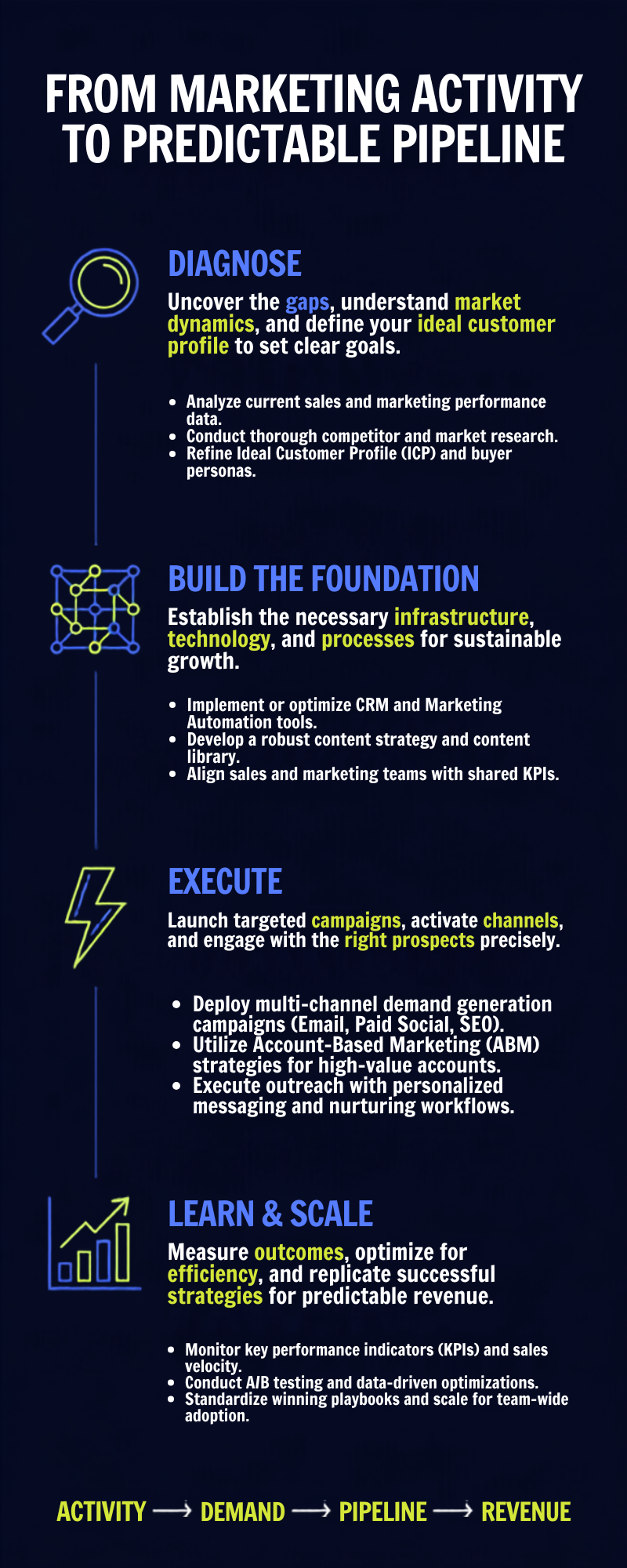
1. Diagnose the revenue bottleneck
Start by understanding what is actually preventing growth.
Look at ICP fit, positioning, acquisition sources, conversion rates, sales acceptance, pipeline velocity and customer economics. A business cannot decide whether it needs more SEO, paid acquisition or demand generation until it understands where the existing system is leaking.
2. Build the foundation
Once the bottleneck is understood, establish the messaging, positioning, analytics and CRM structure needed to measure improvement.
This is where many businesses move too quickly. They launch campaigns before defining the ICP or building consistent messaging, then spend the next six months trying to understand why results are inconsistent.
ACRevScalers’ operating model deliberately places messaging, CRM, analytics and the foundation ahead of channel execution.
3. Execute the channels the business actually needs
Only now should the company decide what to run.
For one business, that might mean SEO and organic lead generation B2B alongside content.
Another may need paid acquisition and outbound.
A SaaS startup may benefit from a multi-channel demand generation agency approach combining search, paid, outbound and nurture.
A company with an internal marketing team may need a B2B GTM consultant to provide strategy and prioritization while the existing team handles execution.
The right answer depends on the diagnosis.
4. Measure, learn and scale
Campaign data should change future decisions.
If one audience produces stronger opportunities, invest more there. If a particular message improves conversion, build around it. If a channel generates cheap leads but weak pipeline, reduce its priority.
This is how marketing becomes progressively more efficient.
The goal is not to keep launching campaigns.
The goal is to make the next campaign smarter than the last one.
How should founders measure whether a digital marketing campaign actually worked?
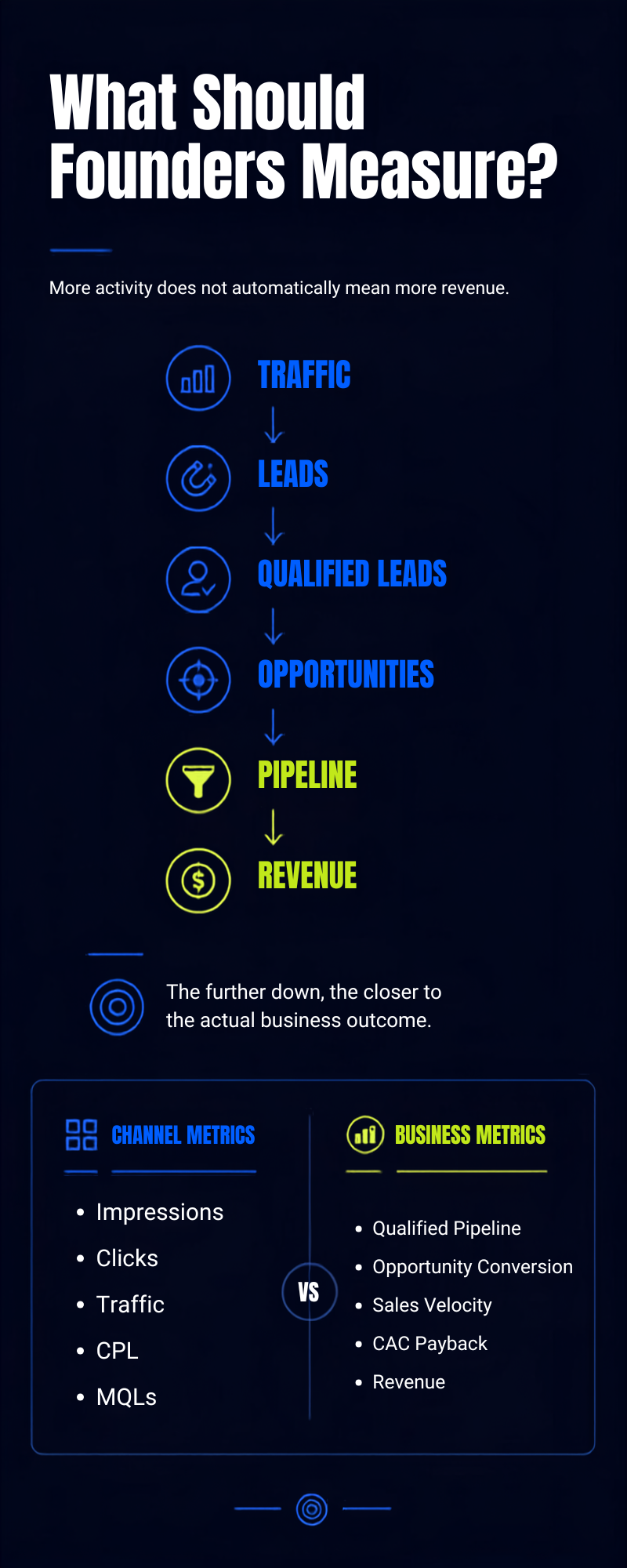
Founders should measure campaigns by how effectively they move qualified buyers towards revenue rather than stopping at traffic, clicks or MQL volume. Channel metrics are useful for optimisation, but pipeline and revenue metrics determine whether the marketing is commercially valuable.
A useful measurement hierarchy looks like this:
Traffic → Leads → Qualified Leads → Opportunities → Pipeline → Revenue
Each stage answers a different question.
- Traffic tells you whether people are finding the company.
- Leads tell you whether some of those visitors are willing to identify themselves.
- Qualified leads show whether the audience fits the business.
- Opportunities indicate whether there is genuine buying potential.
- Pipeline shows the financial value of those opportunities.
- Revenue tells you what ultimately became business.
A founder does not need to ignore the earlier metrics. They need to understand what each metric can and cannot tell them.
For example, a 50% increase in organic traffic is useful information. But if qualified organic opportunities increase by only 3%, the business should investigate the gap rather than celebrate the traffic number as a complete success.
The same principle applies to paid acquisition.
A 30% reduction in CPL sounds positive until the resulting leads produce 20% less pipeline.
Which metrics matter most for B2B growth?
The right metrics depend on the business model and buying cycle, but qualified pipeline, opportunity conversion, sales velocity, CAC, CAC payback, win rate and average contract value should sit much closer to the revenue conversation than impressions or raw lead volume.
McKinsey has also highlighted the commercial importance of treating B2B sales and marketing as increasingly data-driven and integrated functions, noting that organisations adopting more advanced B2B sales approaches have reported materially stronger revenue growth than industry averages.
What should founders look for when evaluating a digital marketing case study?
Founders should look beyond the headline percentage and examine the starting problem, the strategic decision, the quality of the resulting pipeline and what became repeatable after the campaign. A useful case study explains the reasoning behind the result rather than simply presenting an impressive before-and-after number.
Start with the original business problem.
Was the company struggling with demand, conversion, acquisition cost, positioning or sales velocity?
Then look at what actually changed.
Did the team redefine the ICP?
Change the positioning?
Rebuild the landing page?
Introduce a new demand generation strategy?
Improve qualification?
Change the channel mix?
Next, look at the numbers in context.
Suppose a campaign reports a 40% increase in leads. That sounds positive.
But if the company simultaneously increased its acquisition spend by 80%, the result looks very different.
Likewise, a 20% reduction in lead volume may actually be an excellent outcome if sales-qualified opportunities increase by 35%.
The best case studies therefore show the relationship between metrics rather than presenting them individually.
Finally, ask what happened after the campaign.
Did the company retain the audience data? Did it improve its CRM? Did the team document the winning messaging? Did the SEO content continue generating demand? Could the campaign be repeated?
That is where real value sits.
What are the biggest lessons from successful B2B digital marketing campaigns?
Successful B2B campaigns tend to share the same underlying principles: they start with diagnosis, target a clearly defined buyer, connect the funnel and measure progress against pipeline rather than activity alone. The channel mix can vary significantly, but the commercial logic behind the campaign needs to be clear.
- The first lesson is to diagnose before spending. If the problem is conversion, more traffic will not fix it. If the problem is insufficient demand, improving a landing page alone will not create enough opportunities.
- The second is to stop treating lead volume as the finish line. A smaller number of high-intent prospects can create more revenue than a large database of poorly qualified contacts.
- The third is that positioning affects every downstream marketing metric. When the right buyer immediately understands the problem, value and differentiation, acquisition and conversion have a stronger foundation.
- The fourth is to connect marketing and sales around the same definition of success. Marketing should know what sales considers a qualified opportunity, and sales should understand how marketing is creating and nurturing demand.
- The fifth is to build assets that compound. Better messaging, CRM data, SEO authority, automation, content and audience intelligence should make future campaigns more effective.
This is also where the ACRevScalers model differs from a conventional channel-based agency. Its messaging framework positions the company around one revenue system, with specialist execution selected according to the diagnosed business problem rather than selling SEO, paid media or outbound as disconnected products.
Conclusion
The most useful digital marketing case studies do not give founders a list of tactics to copy. They show how a business identified a growth constraint, made a strategic decision, connected the right marketing functions and measured whether the change actually improved the economics of the funnel.
That is a more useful way to think about SEO, demand generation, performance marketing, content, CRM and GTM strategy. None of them is automatically the answer. Their value depends on whether they are solving the right problem and working together.
Key Takeaways
- Diagnose the bottleneck before adding another channel.
- Measure qualified pipeline, not just lead volume.
- Build campaigns around a specific ICP and commercial problem.
- Keep positioning consistent from acquisition through sales.
- Use demand generation to influence buyers before they are ready to fill out a form.
- Turn campaign results into systems, data and knowledge that improve future growth.
The question every founder should eventually be able to answer is simple: Can you explain exactly how your marketing activity becomes pipeline?
If the answer is still a collection of channel reports, the problem may not be that marketing needs to work harder.
It may need to work as one system.
How can ACRevScalers help build that system?
ACRevScalers works with B2B and SaaS founders who need marketing leadership, specialist execution and stronger revenue alignment without building a full internal growth department. Its model combines strategy, demand generation, SEO, performance marketing, CRM, automation and GTM direction around the revenue problem the business is actually trying to solve.
The starting point is not a predetermined channel. It is understanding what is broken, what needs to change, and which combination of capabilities can move the business towards predictable pipeline.
Contact us to book a discovery call to identify the right problem and build the right growth engine.
Because the goal of marketing is not to produce a better report at the end of the month. It is to make revenue growth easier to repeat.
FAQs
What are digital marketing case studies?
Digital marketing case studies explain how a business used marketing strategy and execution to solve a specific growth problem. Strong case studies cover the starting situation, strategic decision, execution, metrics and business outcome rather than focusing only on traffic, clicks or lead volume.
What can B2B companies learn from successful digital marketing campaigns?
B2B companies can learn how ICP selection, positioning, demand generation, SEO, paid acquisition, conversion and sales alignment influence pipeline. The most useful lesson is not necessarily which channel another company used, but why that channel was appropriate for the business problem it was trying to solve.
Why do digital marketing campaigns generate leads but not revenue?
Campaigns can generate leads without revenue when targeting is too broad, positioning is unclear, qualification is weak or marketing and sales are disconnected. Increasing lead volume can make the situation worse if sales receives more contacts without a corresponding increase in buyer quality.
What is the difference between demand generation and lead generation?
Lead generation focuses primarily on identifying and capturing prospects. Demand generation has a broader role: building awareness, educating buyers, creating preference and capturing demand as prospects move closer to a purchase decision.
How should B2B companies measure digital marketing success?
B2B companies should connect channel metrics to commercial outcomes. Qualified pipeline, opportunity conversion, sales velocity, win rate, CAC, CAC payback and revenue contribution provide a more meaningful view of performance than impressions, clicks or raw MQL volume alone.
When should a company consider a fractional marketing team?
A fractional marketing team can be useful when a B2B company needs strategic leadership and multiple specialist capabilities but is not ready to hire a complete internal team. ACRevScalers’ model combines senior growth strategy with specialist execution across demand generation, SEO, content, paid acquisition, web and automation.
Popular News