


A B2B brand strategy framework is often treated as a branding exercise: define the audience, write the messaging, choose the visual identity, and move on to marketing execution. That approach misses the part that matters most to a growing B2B company: whether the brand actually helps create and convert pipeline.
For a B2B SaaS or technology company, brand strategy should sit much closer to revenue strategy. It defines who the company is built for, what problem it owns, why buyers should care, and how that story carries consistently across demand generation, sales and customer conversations.
This is where brand strategy becomes an operating system rather than a marketing asset. A strong framework connects positioning, B2B demand gen alignment, sales enablement and measurement around one commercial objective: predictable revenue growth.
A B2B brand strategy framework connects market category, ICP, positioning, messaging and go-to-market execution into one system. It gives demand generation and sales a common narrative, reduces message inconsistency, helps qualify prospects earlier and creates a foundation for scalable revenue growth.
Why does B2B growth break when brand strategy is disconnected?
A company can have good SEO, paid campaigns, outbound sequences and a capable sales team and still struggle to create pipeline.
The problem is often not the channels. It is the absence of a clear commercial story connecting them.
Consider a SaaS company targeting mid-market operations teams. Its website talks about automation, its ads promote product features, its outbound team leads with cost savings, and sales describes the platform as a productivity solution. None of these messages is necessarily wrong. Together, however, they leave the buyer to figure out what the company actually owns.
That creates friction throughout the funnel. Marketing attracts mixed audiences. Prospects arrive with different expectations. Sales spends time explaining the basic value proposition. Deals take longer because buyers are still working out why the solution matters.
ACRevScalers’ messaging framework takes the opposite approach: diagnosis before prescription. The starting point is the gap between marketing activity and the revenue goal, not the decision to run another channel.
The difference is bigger than messaging
A tactical marketing model asks:
- Which channel should we run?
- How many leads did we generate?
- What was our cost per lead?
- How much traffic did we receive?
A systems-driven model asks:
- Are we reaching the right ICP?
- Does the market understand the problem we solve?
- Does our positioning differentiate us from the status quo?
- Does the same narrative appear across marketing and sales?
- Is activity moving qualified pipeline?
That shift is the foundation of a revenue growth system.
What should a B2B brand strategy framework include?
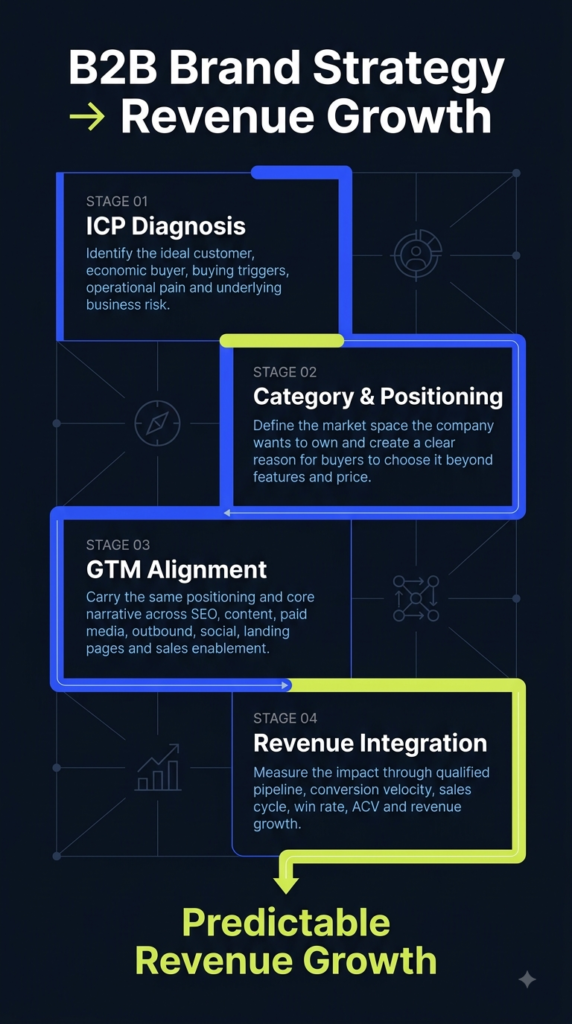
A useful framework needs to connect four layers. They should work sequentially rather than as separate marketing projects.
1. Diagnose the ICP and pain stack
Start with the buyer, not the brand.
Define the economic buyer, operational users, buying triggers, objections and business consequences of leaving the problem unresolved. Then map the pain stack from the surface-level issue to the underlying revenue or operational risk.
For example, “we need more leads” may not be the real problem. The deeper issue could be poor lead quality, unclear positioning, weak qualification or a sales process that cannot convert existing demand.
ACRevScalers’ ICP framework specifically prioritises post-revenue B2B and SaaS businesses where marketing is scattered or disconnected from revenue, rather than treating every business as a fit.
2. Define category and positioning
Once the pain is clear, decide what space the brand should own.
This is where full-funnel B2B brand positioning becomes commercially important. Positioning should give buyers a reason to choose the company beyond a feature comparison.
A SaaS company should not simply say, “We provide workflow automation.” That describes a capability. A stronger position explains the business problem, the category the company wants to own and the outcome it enables.
The goal is to make the buying decision easier before a salesperson enters the conversation.
3. Build one narrative across the GTM system
Positioning has little value if every channel interprets it differently.
Your website, SEO content, paid campaigns, LinkedIn content, outbound messaging, sales decks and demos should reinforce the same strategic idea.
This is where a SaaS brand positioning model becomes operational. The brand narrative should inform:
- Search and content themes
- Paid campaign messaging
- Outbound sequences
- Landing pages
- Sales enablement
- CRM nurture
- Case studies
- Product demonstrations
The channels can change. The underlying commercial story should not.
ACRevScalers’ own framework reflects this principle: the company does not position SEO, outbound or campaigns as isolated products. It frames them as components of one revenue system built around a shared revenue objective.
4. Connect positioning to pipeline metrics
The final stage is where brand strategy stops being subjective.
Measure whether stronger positioning is improving commercial performance.
Useful indicators include:
- Qualified pipeline contribution
- MQL-to-SQL conversion
- Sales cycle length
- Opportunity-to-close rate
- Average contract value
- CAC and CAC payback
- Organic demand contribution
- Win rates by ICP segment
The point is not to claim that every revenue movement comes from branding. It is to determine whether clearer positioning is reducing friction across the revenue system.
How does brand strategy align demand generation and sales?
One of the biggest advantages of a structured framework is consistency.
Imagine a prospect discovers your company through an organic search result. They then see a LinkedIn post, visit a landing page, download a resource and eventually speak to sales.
If every interaction reinforces the same problem, positioning and outcome, the buyer arrives with context.
That is B2B demand gen alignment in practice.
Without it, every channel effectively starts the conversation again.
The result is duplicated effort, inconsistent expectations and more work for sales. With it, marketing can create familiarity before the sales conversation and sales can build on an existing narrative rather than rebuilding it.

What does a revenue-focused brand framework look like in practice?
A practical model is:
ICP diagnosis → Category positioning → GTM alignment → Revenue integration
The first stage determines who matters and why they buy. The second defines what the company should own in the market. The third carries that position across acquisition and sales channels. The fourth measures whether the system is improving pipeline and revenue performance.
This is also why the framework should be built before scaling channels. ACRevScalers’ operating model puts messaging, CRM setup and analytics foundations ahead of channel execution rather than treating foundation work as an optional add-on.
Conclusion
A strong B2B brand is more than a recognisable identity. It gives the entire go-to-market organisation a common commercial direction.
Key Takeaways
- Positioning comes before channel selection. Diagnose the revenue gap before deciding what marketing activity to add.
- Your ICP should shape the brand. Generic positioning creates generic demand.
- One narrative should travel through the funnel. Marketing and sales should not tell different versions of the same story.
- Brand strategy should support pipeline. Measure its effect through conversion, velocity, win rate and revenue metrics.
- Build the system before scaling it. More channels will not fix a weak commercial foundation.
The strongest B2B brands make growth easier because buyers understand the problem, the difference, and the business value before sales has to explain it.
If your marketing is active but revenue is not moving at the same pace, the problem may sit deeper than channel performance. ACRevScalers helps B2B and SaaS founders diagnose the gap between marketing activity and revenue, then build the revenue system needed to close it. The approach starts with diagnosis, not a pre-selected channel or campaign. If your marketing or revenue is stuck, contact revenue growth marketing experts to book a free growth discovery call or send a message now.FAQs
What is a B2B brand strategy framework?
A B2B brand strategy framework is a structured system for defining an ICP, market category, positioning, messaging and go-to-market alignment. Its purpose is to create consistency across marketing and sales while connecting brand decisions to measurable business outcomes such as qualified pipeline and revenue.
Why is brand positioning important for B2B SaaS companies?
B2B SaaS buyers often evaluate complex products involving multiple stakeholders. Clear positioning helps each stakeholder understand the problem being solved, the business value and why the solution is different. It also gives marketing and sales a common narrative to use throughout a longer buying journey.
How does brand strategy support demand generation?
Brand strategy gives demand generation a clear audience, problem and message to build around. Instead of creating disconnected campaigns across SEO, paid, outbound and social channels, teams can use one positioning framework to create consistent demand and capture prospects with stronger context.
What is the difference between brand strategy and brand identity?
Brand identity covers how a company looks and presents itself, including visual elements and brand expression. Brand strategy defines the commercial foundation behind that identity: who the company serves, what it stands for, what problem it owns and why customers should choose it.
How does a brand strategy contribute to revenue growth?
A strong brand strategy can reduce friction throughout acquisition and sales by making the company’s value easier to understand. When positioning is consistently applied across the funnel, prospects can become better qualified before sales engagement, while sales teams spend less time explaining basic value and more time progressing opportunities.

Ashvini Vyas is the founder of ACRevScalers and a B2B growth marketing strategist with nearly two decades of experience building revenue-aligned marketing systems for SaaS, technology, and B2B platforms across Australia, the US, and the UK. Her work spans go-to-market strategy, demand generation, and fractional CMO advisory, with a particular focus on translating complex, technical products into marketing that converts.