



What is the best way to measure SEO success?
The best way to measure SEO success is to connect search visibility with business outcomes. Rankings and organic traffic tell you whether SEO is gaining visibility, while conversions, qualified leads, pipeline, and revenue tell you whether that visibility is actually helping the business grow.
A useful SEO measurement model looks like this:
Visibility → Traffic → Engagement → Conversion → Qualified Pipeline → Revenue
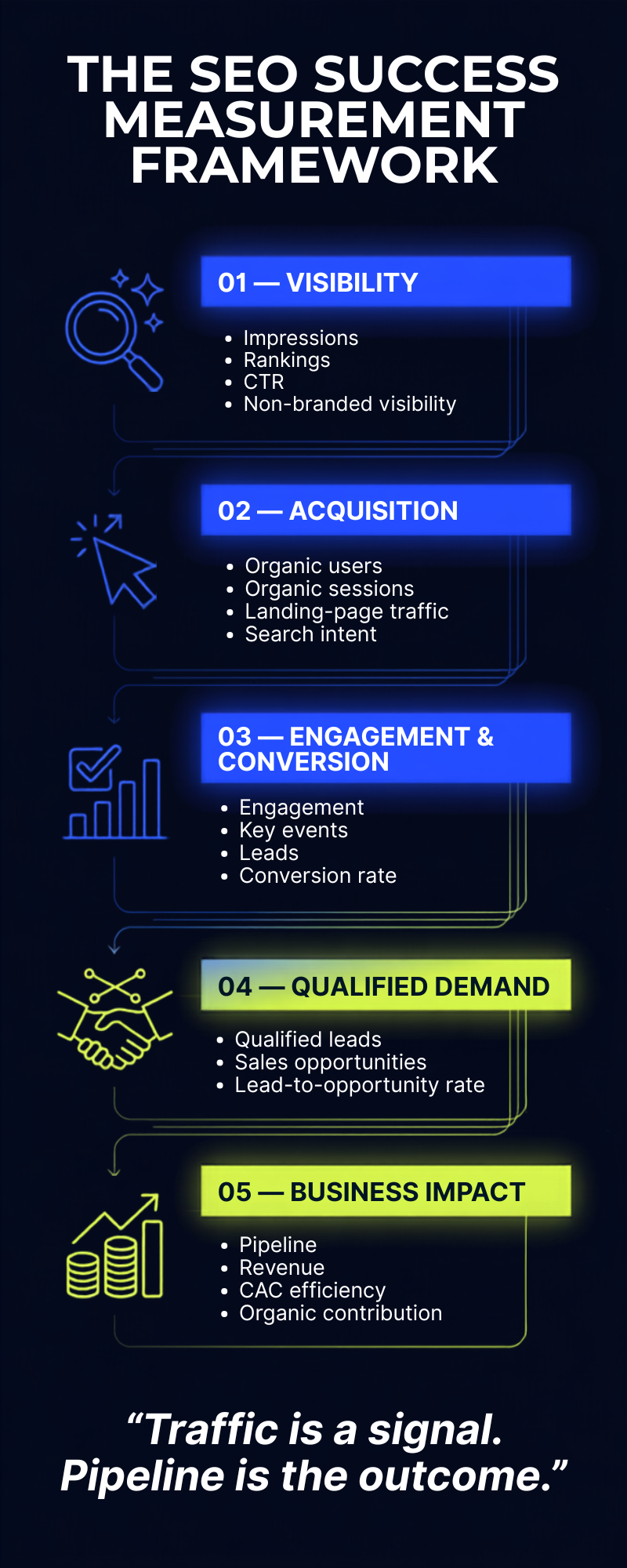
The further down this chain you go, the closer you get to the commercial value of SEO.
That does not make rankings or traffic irrelevant. They are diagnostic signals. If impressions suddenly fall, something may have changed in search demand, rankings, technical health or Google’s search results. If traffic increases but conversions do not, the problem may sit with search intent, landing pages or conversion architecture.
This is why an SEO report that only shows keyword positions and traffic can leave a founder with more numbers but fewer answers.
Which SEO KPIs should you track?
The most useful SEO KPIs fall into five groups: visibility, traffic, engagement, conversion and revenue. Tracking all five gives you enough context to understand not only whether SEO is improving, but why performance is changing.
1. Visibility KPIs
These tell you whether your website is becoming more visible in search.
Track:
- Search impressions
- Average position
- Ranking keywords
- Non-branded visibility
- Branded visibility
- SERP features where relevant
- Search visibility by landing page
- Search visibility by topic or keyword cluster
Google Search Console’s Performance report provides four core search metrics: clicks, impressions, CTR and average position. You can analyse them by queries, pages, countries, devices and search appearance.
2. Traffic KPIs
Traffic tells you whether that visibility is bringing people to the website.
Track:
- Organic sessions
- Organic users
- New organic users
- Organic landing-page traffic
- Organic traffic by country
- Organic traffic by device
- Brand vs non-brand traffic
GA4’s Traffic acquisition report lets you analyze where sessions come from, including organic search, paid search, referral, social and other channels. (Google Support)
3. Engagement KPIs
This helps determine whether visitors found what they were looking for.
Track:
- Engagement rate
- Average engagement time
- Pages per session where useful
- Landing-page engagement
- Scroll or interaction events where configured
- Key events
Engagement should be interpreted carefully. A visitor spending three minutes on a page is not automatically more valuable than someone spending 45 seconds. If the page answers the question quickly and the visitor then converts, the shorter session may actually represent better performance.
4. Conversion KPIs
This is where SEO starts becoming a business metric.
Track:
- Contact form submissions
- Demo requests
- Consultation requests
- Calls
- Downloads
- Sign-ups
- Qualified leads
- Sales opportunities
GA4 allows businesses to configure important actions such as key events and, in supported reporting, track lead stages such as new, qualified and converted leads.
5. Revenue KPIs
For a mature SEO program, connect organic acquisition to:
- Pipeline generated
- Opportunity value
- Closed-won revenue
- Customer acquisition cost
- Revenue per organic visitor
- Organic conversion rate
- Customer lifetime value where attribution supports it
This is where SEO performance stops being a marketing-only conversation.
Why are rankings not enough to measure SEO success?
Rankings are useful for diagnosing SEO performance, but they are not a reliable measure of business success on their own. A ranking improvement matters when it increases qualified visibility, attracts the right visitors and contributes to conversions or revenue.
Consider a B2B SaaS website targeting a keyword with roughly 2,000 monthly searches.
The page moves from position 18 to position 7.
That sounds like a strong result.
But six months later, organic leads have barely changed.
A deeper analysis reveals that the page is attracting researchers who are looking for general information, while the company’s actual buyers search for more specific commercial terms.
The ranking improved.
The business did not.
Now consider another page that moves from position 11 to position 6 for a lower-volume keyword. Traffic increases by only 250 visits a month, but those visitors are highly relevant to the company’s ICP. The page generates eight additional enquiries and two sales opportunities.
The second result may be much more valuable.
This is why keyword rankings should be treated as a diagnostic KPI rather than the final SEO KPI.
Rankings answer:
Are we becoming more visible?
They do not answer:
Are we becoming more commercially relevant?
That distinction is particularly important for B2B companies where one qualified opportunity can be worth more than hundreds of low-intent visitors.
How should you measure organic traffic?
Organic traffic should be measured by volume, quality and commercial relevance rather than by total sessions alone. Segmenting organic traffic by landing page, search intent, audience, geography and device helps reveal whether SEO is attracting the right visitors.
Suppose organic traffic increases from 20,000 to 32,000 monthly sessions.
The marketing report celebrates a 60% increase.
But the founder asks a better question: What happened to the business?
The SEO team discovers that most of the additional traffic came from informational blog posts. Those pages are useful for awareness, but they rarely generate enquiries.
Meanwhile, commercial service pages have received almost no traffic growth.
That tells you something important.
The SEO program may be improving visibility without improving demand capture.
A stronger measurement approach separates traffic into groups such as:
Informational traffic
People learning about a topic.
Commercial research traffic
People evaluating possible solutions.
High-intent traffic
People actively looking for a provider, product or service.
For B2B SaaS, this distinction is particularly important because buying journeys are long and involve multiple research stages.
GA4’s Landing page report can be combined with session source/medium data to understand which acquisition sources are bringing visitors to specific landing pages.
That makes it easier to identify whether your SEO strategy is sending valuable searchers to the pages that matter.
What is the difference between Google Search Console and GA4 for SEO?
Google Search Console explains how your website performs in Google Search, while GA4 explains what visitors do after they arrive on your website. You need both because neither platform provides the complete SEO picture on its own.
Search Console is particularly useful for:
- Search queries
- Impressions
- Search clicks
- CTR
- Average position
- Search pages
- Search visibility trends
GA4 is more useful for:
- Organic sessions
- Users
- Landing pages
- Engagement
- Key events
- Lead generation
- Conversion paths
- Revenue where configured
The numbers will not match exactly.
Google explicitly notes that Search Console clicks and GA4 sessions are measured differently, so discrepancies between the platforms are normal. (Google for Developers)
For example, you might see:
Search Console
8,200 organic clicks
GA4
7,600 organic sessions
That does not automatically mean something is broken.
The two systems use different methodologies, attribution and processing rules.
The important thing is to establish a consistent reporting process and focus on trends and relationships, not obsess over making every number identical.
How do you calculate organic conversion rate?
Organic conversion rate is calculated by dividing the number of desired conversions from organic traffic by the relevant organic traffic volume, then multiplying by 100.
The basic formula is:
Organic Conversion Rate = Organic Conversions ÷ Organic Sessions × 100
For example, if a website receives 10,000 organic sessions and generates 150 form submissions:
150 ÷ 10,000 × 100 = 1.5%
That number becomes more useful when you segment it.
Imagine:
- Blog traffic: 8,000 sessions
- Commercial-page traffic: 2,000 sessions
- Total enquiries: 150
The overall 1.5% conversion rate hides an important difference.
Suppose the blog converts at 0.5%, while commercial pages convert at 5%.
The SEO strategy may not need more overall traffic.
It may need more of the right traffic reaching the commercial pages.
This is one reason SEO reporting should connect landing pages, search intent and conversion data rather than treating the entire website as one traffic bucket.
How should you measure SEO-generated leads?
SEO-generated leads should be measured by both quantity and quality. The important progression is not simply organic traffic to leads, but organic traffic to qualified leads, sales opportunities and eventually revenue.
Consider a B2B technology company generating 100 organic leads a month.
On paper, that looks healthy.
After sales reviews the data, only 18 are considered qualified and six become genuine opportunities.
Now imagine the SEO team changes its content strategy and organic leads fall to 75.
That initially looks like a decline.
But the new numbers are:
- 75 organic leads
- 28 qualified leads
- 11 opportunities
The SEO program has generated fewer leads but significantly more commercial value.
That is the type of change a founder should want to see.
GA4’s lead acquisition reporting can distinguish between new leads, qualified leads and converted leads when the relevant events are implemented correctly. (Google Support)
This also connects SEO with the wider B2B demand generation system. Organic search should not be judged only by what happens before the form submission. Its value continues through qualification and pipeline.
How do you measure SEO’s impact on pipeline and revenue?
Measure SEO’s commercial impact by connecting organic acquisition data with CRM outcomes. The strongest setup allows the business to trace relevant organic interactions through lead qualification, opportunity creation and closed revenue.
For example, consider a B2B SaaS company that generates:
- 1,000 monthly organic leads
- 120 qualified leads
- 35 sales opportunities
- $420,000 in influenced pipeline
The next quarter, traffic falls slightly because several informational keywords decline.
However:
- Organic leads fall to 900
- Qualified leads rise to 135
- Opportunities rise to 41
- Pipeline reaches $510,000
A traffic-only SEO report would call this a decline.
A revenue-focused report would call it an improvement.
This is the difference between measuring SEO activity and measuring SEO contribution.
ACRevScalers’ business model explicitly includes Google Analytics and Search Console setup, CRM pipeline construction and monthly pipeline/performance review as part of its growth foundation.
The reason is simple: if marketing data and CRM data live in separate worlds, it becomes difficult to determine whether organic growth is actually producing commercial value.
What should you measure for technical SEO performance?
Technical SEO should be measured through crawlability, indexability, site performance and the accessibility of important pages rather than through rankings alone. Technical problems often become visible in search performance only after they have already affected the website.
Monitor:
- Indexed pages
- Excluded pages
- Crawl errors
- Server errors
- Redirect errors
- Canonical issues
- XML sitemap status
- Core Web Vitals
- Page speed
- Mobile performance
- Orphan pages
- Broken internal links
Do not treat technical SEO as a separate activity. Rather, use it to establish whether search engines can actually crawl, render, and index the pages your SEO strategy is trying to grow. If you do not know what should be taken care of, here is an article written by our marketing head and growth marketing strategist, Ashvini Vyas, covering the Technical SEO Checklist for Better Website Performance
A technically strong page cannot guarantee rankings.
But a technically broken page can prevent even excellent content from performing properly.

How should you measure SEO content performance?
SEO content should be evaluated according to the job each piece of content is supposed to perform. A top-of-funnel educational article should not be judged by exactly the same conversion target as a commercial service page.
For example, a technical SEO guide might be designed to:
- Attract organic traffic
- Build topical authority
- Earn backlinks
- Introduce the brand
- Move readers toward commercial pages
A service page may instead be expected to:
- Rank for commercial searches
- Generate enquiries
- Support sales conversations
- Convert high-intent visitors
A case study has another role.
It may attract fewer visitors but influence buyers who are already evaluating providers.
This is why Digital Marketing Case Studies: Real-World Lessons From Successful Campaigns should be measured differently from a broad educational article. The important question is not simply how much traffic the case study receives. But whether the people reading it are commercially relevant and whether it contributes to the buying journey.
Which SEO metrics should you report to a founder or CEO?
A founder-level SEO report should focus on a small number of metrics that explain visibility, qualified demand and business impact. The detailed keyword and technical data can sit behind the executive view rather than overwhelming the person responsible for the revenue target.
A useful monthly dashboard could contain:
Visibility
- Organic impressions
- Non-branded clicks
- Important keyword movement
Acquisition
- Organic users
- Organic sessions
- Top organic landing pages
Quality
- ICP-fit organic leads
- Organic conversion rate
- Qualified lead rate
Pipeline
- Opportunities created
- Pipeline influenced/generated
- Sales velocity where measurable
Technical health
- Indexation issues
- Critical crawl issues
- Core Web Vitals
That is enough to answer the questions most founders actually care about:
Are we getting more visible?
Are the right people finding us?
Are they taking meaningful action?
Is that activity creating pipeline?
Is anything technical preventing growth?
How should you interpret a sudden drop in organic traffic?
A sudden organic traffic decline should be investigated across search demand, rankings, indexing, technical health, landing pages and analytics before assuming that an SEO strategy has failed.
Start with Google Search Console.
Look at:
- Queries
- Pages
- Countries
- Devices
- Search appearance
- Clicks
- Impressions
- CTR
- Average position
Then compare the timing.
Did impressions fall?
If yes, search visibility or demand may have changed.
Did impressions remain stable but clicks fall?
CTR, rankings or SERP presentation may be involved.
Did clicks remain stable but GA4 traffic fall?
Check analytics configuration, attribution and tracking.
Did organic traffic fall only on certain pages?
Investigate those templates, rankings, content changes and technical issues.
This approach prevents a common mistake: changing the SEO strategy before understanding what actually changed.
Google’s Search Console Insights report can also surface trending-up and trending-down pages and queries, which can help identify where further investigation is needed.
Why should you separate branded and non-branded SEO traffic?
Branded and non-branded organic traffic represent different types of demand, so combining them can make SEO performance look stronger or weaker than it actually is. Non-branded visibility is usually more useful when assessing whether SEO is expanding reach beyond people who already know the company.
Imagine organic traffic increases by 35%.
That sounds positive.
But the increase comes almost entirely from searches containing the company’s name.
The business may have stronger brand awareness, but SEO has not necessarily expanded its ability to capture new demand.
Now consider a smaller increase where non-branded clicks rise by 18% across high-intent commercial queries.
That may indicate that the SEO strategy is reaching new prospects.
For B2B businesses, this distinction becomes particularly important because branded searches can be influenced by LinkedIn, outbound, referrals, events and other marketing channels.
SEO reporting should therefore separate:
Branded search
People already looking for you.
Non-branded search
People looking for the problem, category or solution.
Both matter.
They simply answer different questions.
How should SEO KPIs change as the strategy matures?
SEO KPIs should become increasingly commercial as the program matures. Early-stage SEO may focus more heavily on technical health, indexation, impressions and rankings, while a mature program should place greater emphasis on qualified organic demand, pipeline and revenue.
A sensible progression looks like this:
Stage 1: Foundation
Focus on:
- Technical health
- Indexability
- Crawlability
- Sitemap health
- Keyword targeting
- Initial rankings
Stage 2: Visibility
Focus on:
- Impressions
- Clicks
- Rankings
- Non-branded visibility
- Organic traffic
Stage 3: Demand
Focus on:
- Commercial landing-page traffic
- Organic conversions
- Qualified leads
- High-intent queries
Stage 4: Revenue
Focus on:
- Opportunities
- Pipeline
- Revenue
- CAC efficiency
- Organic contribution to growth
This progression matters because a six-month-old SEO program should not be judged using exactly the same expectations as an established organic acquisition engine.
The metrics should mature with the strategy.
What is a good SEO reporting framework?
A good SEO reporting framework connects what changed, why it changed and what should happen next. A report that only presents numbers forces the founder to interpret the data themselves.
A stronger monthly report might follow this structure:
- What changed?
Organic traffic increased 22%.
- Where did it change?
Most growth came from five commercial landing pages.
- Why did it change?
Those pages gained visibility for a cluster of high-intent searches after content and internal-link improvements.
- Did the change matter?
Qualified organic enquiries increased from 32 to 47.
- What happens next?
Expand the successful topic cluster, strengthen internal links and improve conversion paths on the highest-traffic pages.
Now the report tells a story.
The founder can see what happened without having to interpret 40 charts.
How should SEO analytics connect with a wider revenue growth system?
SEO analytics should connect search performance with the broader marketing and sales system so that organic growth can be evaluated alongside paid acquisition, demand generation, outbound and CRM outcomes. SEO should not become another isolated reporting channel.
This matters because buyers rarely experience one channel at a time.
A prospect might:
- See a LinkedIn post.
- Search the company name.
- Read an SEO article.
- Return through an organic search.
- Download a resource.
- Receive an email.
- Speak with sales.
- Become an opportunity.
Which channel gets credit?
GA4’s attribution and traffic-source dimensions are designed to help businesses analyse where users come from and how different touchpoints contribute to their journeys. (Google Support)
The answer will never be perfectly clean.
B2B journeys are too complex for that.
But the more important objective is to avoid judging SEO in isolation from the rest of the acquisition system.
We suggest reading our latest article covering, Why Your Revenue Problem Isn’t a Marketing Problem. Undoubtedly, it is a useful companion to this discussion. The broader issue is often not that one marketing channel is failing. It is that nobody has connected marketing performance to the actual revenue constraint.
What should you do if SEO traffic is growing but leads are not?
If organic traffic is growing without corresponding lead growth, investigate search intent, landing-page relevance, conversion architecture, audience quality and sales qualification before simply publishing more content. More traffic will not solve a conversion problem.
Start by identifying which pages are producing the traffic.
Then ask:
- Are these pages attracting the ICP?
- Are the keywords commercially relevant?
- Are visitors reaching service or product pages?
- Are CTAs visible and relevant?
- Are forms creating unnecessary friction?
- Are conversions tracked correctly?
- Are organic leads being qualified?
- Does sales consider the leads valuable?
Consider a SaaS website that grows organic traffic by 70% but sees qualified opportunities rise by only 5%.
The obvious response is often to publish more content.
The better response is to investigate the existing traffic first.
There may already be enough demand.
The website simply may not be converting or routing it effectively.
How can SEO analytics help decide what to optimize next?
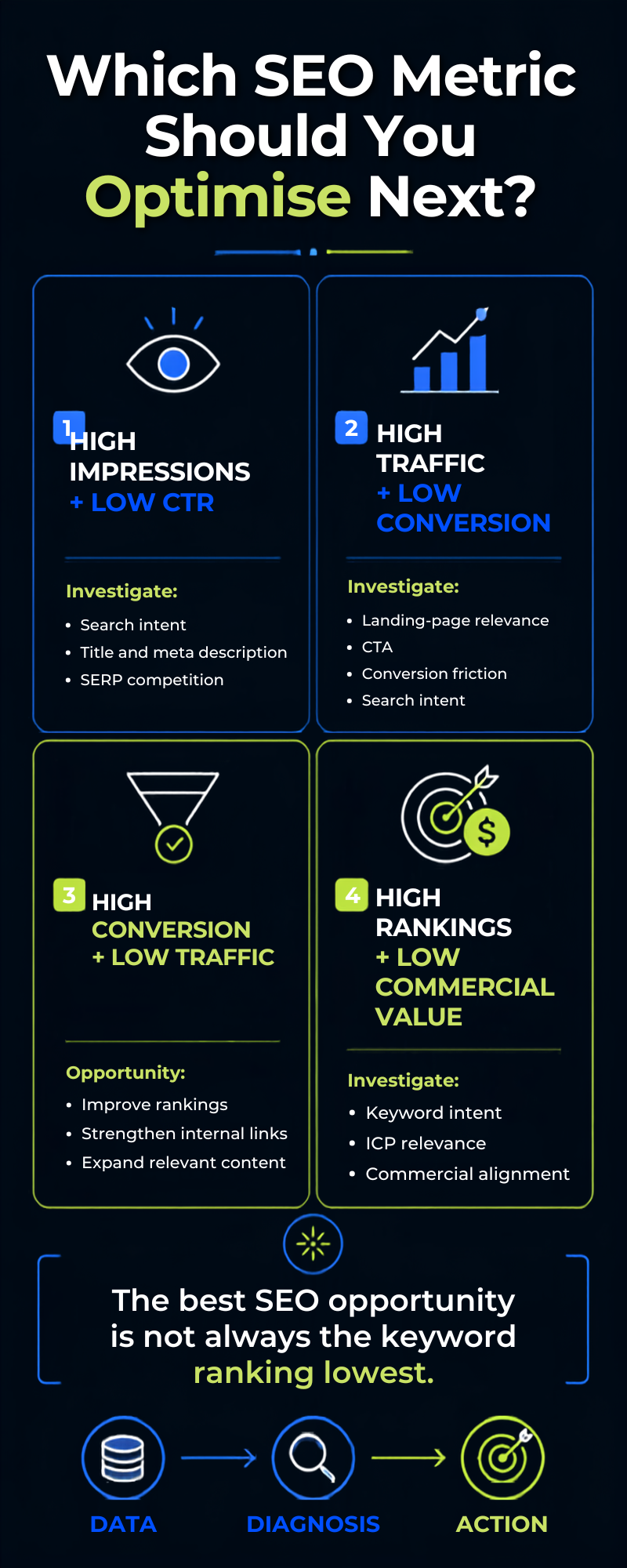
SEO analytics should help determine where the next investment is likely to create the most commercial value. The best opportunity is not always the page with the lowest ranking; it may be a page already receiving strong impressions or relevant traffic but failing to convert.
Look for four types of opportunity.
High impressions + low CTR
The page is visible, but the search result may not be compelling enough.
Review:
- Title
- Meta description
- Search intent
- SERP competition
- Rich-result eligibility
High traffic + low conversion
The page attracts visitors but fails to move them forward.
Review:
- Intent
- Content relevance
- CTA
- Landing-page structure
- Offer
- Internal links
High conversion + low traffic
This is often an excellent SEO opportunity.
The page already converts.
Now improve its visibility.
High rankings + low commercial relevance
Do not automatically celebrate the ranking.
Ask whether the query represents the audience and problem the business actually wants to attract.
This type of analysis turns SEO analytics into a decision-making system, rather than a reporting exercise.
What SEO KPIs should you track every month?
At minimum, track organic visibility, traffic, engagement, conversions, qualified leads and pipeline every month. Technical health should also be monitored so that changes in search performance can be investigated before they become larger problems.
A practical monthly scorecard is:
Search visibility
- Impressions
- Clicks
- CTR
- Average position
- Non-branded clicks
Organic acquisition
- Organic users
- Organic sessions
- Top landing pages
- New organic users
Engagement
- Engagement rate
- Engagement time
- Key events
Conversion
- Organic leads
- Conversion rate
- Qualified leads
- Lead-to-opportunity rate
Revenue
- Opportunities
- Pipeline
- Closed revenue where measurable
Technical
- Indexed pages
- Crawl errors
- Core Web Vitals
- Sitemap health
- Major canonical/indexing issues
The exact dashboard will vary by business model, but the principle should remain the same:
Do not report 40 metrics simply because your tools provide them. Report the metrics that help you make the next decision.
What is the biggest mistake businesses make when measuring SEO success?
The biggest mistake is treating SEO reporting as proof that work was completed rather than evidence that the business is moving in the right direction. Rankings, traffic, published content and technical fixes demonstrate activity; qualified pipeline and revenue demonstrate commercial impact.
A team can publish 20 articles.
It can fix 150 technical issues.
It can build hundreds of backlinks.
It can move 50 keywords onto page one.
And the business can still ask:
“Where are the leads?”
That does not mean the work was worthless.
It means the measurement framework stopped too early.
The strongest SEO programs connect the dots between search visibility and commercial outcomes. They also recognise when the problem is not SEO at all.
Sometimes organic traffic is healthy but conversion is weak.
Sometimes rankings are healthy but the keyword strategy is wrong.
Sometimes the website is technically sound but the offer is poorly positioned.
Sometimes marketing is generating demand, but the CRM and sales process cannot capture it properly.
The numbers help you find that distinction.
How should founders evaluate SEO success?
Founders should evaluate SEO by asking whether the right buyers are becoming easier to reach, easier to convert and more likely to enter the sales pipeline. Traffic and rankings matter, but they should support a bigger commercial story rather than become the story themselves.
A useful founder-level question is:
“If SEO stopped tomorrow, what evidence would show me that it had been creating business value?”
If the answer is only rankings and traffic, the measurement framework needs work.
If the answer includes qualified leads, opportunities, pipeline, assisted conversions and revenue, the company has a much stronger understanding of SEO’s role.
This is particularly important when deciding whether to invest more in SEO and demand generation for B2B SaaS. SEO can create compounding organic demand, but it works best when the strategy is connected to positioning, content, conversion and CRM data rather than managed as a standalone traffic channel.
Conclusion
SEO success cannot be reduced to rankings, traffic or a green score in an SEO platform. A useful measurement framework connects search visibility with visitor quality, conversions, qualified opportunities and revenue while using technical and engagement data to explain why performance is changing.
Key Takeaways
- Track visibility first, but don’t stop there. Impressions, clicks and rankings show whether SEO is gaining search visibility.
- Measure traffic quality. Understand which landing pages and search intents are attracting the right audience.
- Connect SEO to conversions. Organic leads and qualified opportunities are stronger indicators than traffic alone.
- Bring CRM data into the conversation. Pipeline and revenue show whether SEO is contributing to business growth.
- Use GA4 and Search Console together. One explains search performance; the other helps analyse what happens after visitors arrive.
- Keep technical SEO under measurement. Indexing, crawlability, Core Web Vitals and site health can affect everything above them.
- Report insights, not just numbers. Every monthly report should explain what changed, why it changed and what you recommend doing next.
SEO becomes much easier to manage when the reporting stops being a collection of metrics and starts becoming a decision-making system.
The goal is not to prove that SEO is busy.
The goal is to know whether SEO is making the business easier to find, easier to trust and easier to buy from.
Looking for expert SEO and growth guidance?
ACRevScalers helps B2B and SaaS businesses connect SEO, organic demand generation, analytics, CRM and broader growth strategy instead of treating each channel as a separate activity. Its growth programs include Google Analytics and Search Console setup, SEO audits, organic lead generation, demand generation and ongoing pipeline and performance review.
If your SEO reports show traffic and rankings but you still cannot clearly explain how that activity is contributing to pipeline, connect with ACRevScalers for expert guidance on building a more measurable organic growth system.
FAQs
What is the most important KPI for measuring SEO success?
There is no single SEO KPI that works for every business. For B2B companies, qualified organic leads, sales opportunities and pipelines are usually more commercially meaningful than rankings or traffic alone, while impressions, clicks and rankings help explain changes in search visibility.
How do I measure SEO performance in Google Analytics 4?
Use GA4’s Acquisition reports to analyse organic traffic, landing pages, engagement and key events. The Traffic acquisition report can show organic search sessions and associated engagement, while lead and conversion events can help connect organic acquisition with business actions.
What is the difference between Google Search Console and GA4 for SEO?
Search Console measures how your website performs in Google Search, including impressions, clicks, CTR and average position. GA4 focuses on what users do after arriving on the website, including traffic sources, engagement, key events and conversions. The numbers from the two platforms should not be expected to match exactly.
Why is organic traffic increasing but SEO leads are not?
This usually means the additional traffic may not have enough commercial intent, or visitors may be reaching pages that do not convert effectively. Review search intent, landing pages, CTAs, conversion tracking and lead qualification before deciding that you simply need more SEO traffic.
How often should SEO KPIs be reviewed?
Core SEO metrics should generally be reviewed monthly, while major technical issues and significant traffic changes should be investigated as they occur. Monthly reporting provides enough data to identify trends without encouraging teams to overreact to normal short-term fluctuations.
Should SEO reporting include revenue?
Yes, wherever reliable attribution is possible. Revenue is the strongest commercial outcome, although B2B businesses with long sales cycles may need to use qualified leads, opportunities and pipeline as intermediate measures before closed revenue can be attributed confidently.
Ashvini Vyas is the founder of ACRevScalers and a B2B growth marketing strategist with nearly two decades of experience building revenue-aligned marketing systems for SaaS, technology, and B2B platforms across Australia, the US, and the UK. Her work spans go-to-market strategy, demand generation, and fractional CMO advisory, with a particular focus on translating complex, technical products into marketing that converts.
Related News


Technical SEO Checklist for Better Website Performance

On-Page SEO Best Practices That Drive Real Results
Popular News