


ACRevScalers

The Strategic Breakdown of the Google June 2026 Spam Update

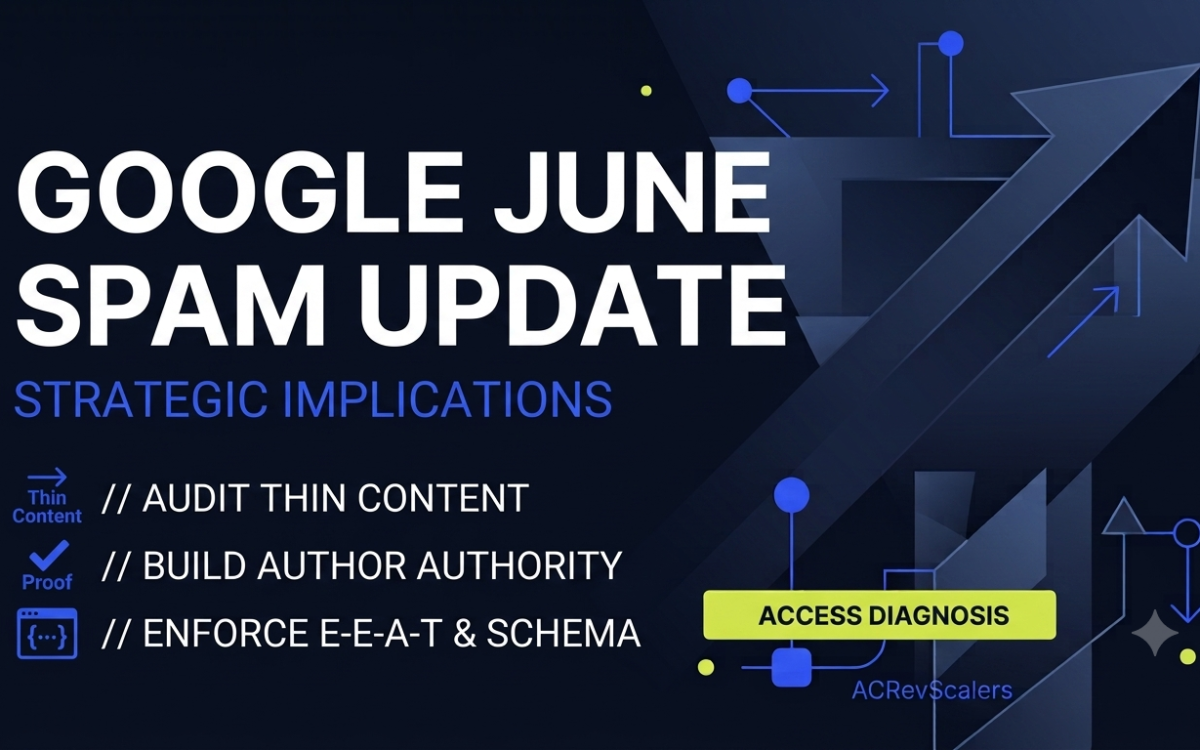
Google june spam updated decoded


When Google finalized its June 2026 Spam Update, a rapid global rollout completed in just 48 hours via its SpamBrain AI detection systems, the marketing world responded with predictable panic.

Agencies started scrubbing sites. SEO managers scrambled to edit keyword density. B2B SaaS founders sent urgent messages asking why organic metrics shifted overnight.

Most agencies will try to sell you a quick audit, a new link package, or a batch of replacement articles. They lead with channels because they sell activity, not outcomes.

If an automated algorithm update damages your organic acquisition, your problem was never Google. Your problem is that you are running scattered content activity with nobody responsible for whether it turns into pipeline.

Here is what the June 2026 update actually is, who took the hit, concrete examples of what went wrong, and how to build a unified system that leverages this update to dominate organic search and AI answer engine (AEO/GEO) citations.


What Is the June 2026 Spam Update?

On June 24, 2026, Google initiated its second spam update of the year. By June 26, the rollout was fully marked complete on the Search Status Dashboard.

Key Update ParameterDetails
Rollout Window

June 24, 2026 to June 26, 2026 (48 Hours)

Core Target System

SpamBrain (AI Automated Spam Detection Engine)

Scope & Language

Global across all regions and all languages

Enforcement Type

Algorithmic demotion based on existing spam rules

Spam Update vs. Core Update: The Critical Difference

  • Core Updates: Broad, sitewide recalibrations of how Google evaluates overall content helpfulness, authority, and domain relevance.
  • Spam Enforcement Updates: Precise, automated algorithmic actions powered by SpamBrain targeting sites that use manipulative tactics to trick search rankings rather than earn them.

Google introduced no new rules with this update. It simply tightened algorithmic detection for existing policy violations, specifically targeting automated, low-value content patterns.

Who Got Hit? (And Why Strategy-Less Content Failed)

Sites hit by this rollout did not fail by accident; they failed because they treated SEO as a volume game rather than a strategic asset.

  • Scaled Content Abusers: Publishers and brands generating hundreds of superficial, unedited AI articles or dynamic template pages to catch thousands of long-tail keyword variations.
  • Scraping and Rephrased Information Networks: Sites taking high-ranking competitor content, running it through language models to change sentence structures, and republishing it without adding a single original insight, data point, or expert opinion.
  • Thin Commercial and Product Frameworks: Ecommerce and SaaS platforms using thin product variant pages or shallow tool comparisons that copy manufacturer descriptions without providing actionable guidance for buyers.
  • Search-First Manipulators: Pages built explicitly to capture clicks for monetization (ads, affiliate links, superficial lead traps) that offer zero functional value to a human decision-maker.

Concrete Examples: Manipulative Tactics vs. Revenue System Fixes

To understand why SpamBrain targeted specific assets, consider these real-world scenarios contrasting typical agency execution against a true strategic model:

Example 1: Scaled B2B Blog Execution

  • What Got Hit: A SaaS company published 120 AI-generated articles targeting micro-variations like “Best HR Software for Remote Teams in Sydney” and “Best HR Software for Tech Startups in Melbourne.” The articles used identical templates, generic tips, and swapped location keywords. SpamBrain detected programmatic scaling and suppressed the entire sub-folder.
  • System Fix: Prune the 120 thin pages. Build one definitive guide titled “The Remote B2B HR System Framework.” Embed real case studies, direct quotes from your Head of People, and actionable workflow breakdowns.

Example 2: The E-E-A-T and Citation Disconnect

  • What Got Hit: A financial software blog published an article titled “How to Structure B2B Enterprise Pricing.” The piece was credited to an anonymous “Editorial Team,” contained no primary research, and cited generic advice from years past. Google demoted the URL, and AI platforms excluded it from answer citations.
  • System Fix: Re-attribute the piece to your Chief Revenue Officer. Add verified Author Schema (Person JSON-LD), link to external industry accreditations, and insert proprietary data showing real conversion rates across enterprise pricing models.

How to Recover If You Took a Hit

Algorithmic spam demotions do not offer manual reconsideration requests. You cannot submit a form and ask Google to forgive your site. Recovery requires identifying the breakdown, removing the manipulative friction, and allowing Google’s automated systems to recrawl and reassess your site over time, a process that typically takes several months.

Step 1: Isolate the Data in Search Console

Compare Search Console performance metrics from before June 24 against the period following June 26. Isolate whether the drop occurred on high-intent revenue terms or vanity informational queries.

Step 2: Purge Scaled Thin Assets

Audit content against the scaled abuse standard. If articles were created primarily to manipulate search crawlers or fill a publishing schedule, apply noindex directives, remove redundant templates, or consolidate overlapping thin pages into authoritative pillar assets.

Step 3: Enforce Author E-E-A-T and Schema

Implement clear, verifiable author attribution across all copy. Inject first-party proof, proprietary client data, original workflows, and JSON-LD schema so search bots and AI scrapers can verify your entity authority.

Step 4: Re-Align Messaging to Pipeline

Ensure every remaining page directly serves a buyer problem, connecting search intent straight to revenue outcomes.

How to Leverage This Update to Win in Traditional Search, AEO, and GEO

While competitors are panicking and deleting thousands of low-quality pages, this update creates an immediate strategic advantage for authoritative brands.

When Google suppresses thin content, it leaves massive gaps in search engine results pages and AI answer engine indices. Generative models like ChatGPT, Perplexity, and Google AI Overviews rely on authoritative sources to fetch citations.

Strategic Leverage PointExecution Action
Topical Authority Concentration

Stop writing dozens of fragmented articles. Build deeply authoritative resources that solve complete business problems from strategy to execution.

Structured Entity SchemaDeploy clear, validated JSON-LD schema (Organization, Person, Article, FAQ). AI retrieval engines use structured markup to verify entities and extract citations.
Outcome-Led Messaging

Structure your content around real buyer pain points. Frame your copy around clear business outcomes rather than empty industry jargon.

Stop Buying Channels. Start Buying a System.

The June 2026 Spam Update was not a surprise; it was an inevitability. It penalized brands that bought isolated SEO activity, published filler for search engines, and hoped for traffic.

Most B2B founders do not have a search problem. They have a revenue system problem: marketing activity running in every direction with nobody accountable for whether it generates pipeline.

At ACRevScalers, we do not sell isolated SEO packages or temporary fixes. We build one scalable revenue growth partnership for B2B and SaaS founders, diagnosing the exact gap between your marketing output and your revenue targets before running the system at the scale your business requires.

Before you waste another six months reacting to algorithm updates, let us diagnose what is actually broken in your revenue system.


Ashvini Vyas, Founder of ACRevScalers

Ashvini Vyas is the founder of ACRevScalers and a B2B growth marketing strategist with nearly two decades of experience building revenue-aligned marketing systems for SaaS, technology, and B2B platforms across Australia, the US, and the UK. Her work spans go-to-market strategy, demand generation, and fractional CMO advisory, with a particular focus on translating complex, technical products into marketing that converts.

Explore More About Ashvini Vyas →

LinkedInInstagramFacebookYouTube

Join Our Team

Looking for a new Positions?

Cart (0 items)

Learn About Us

We are a results-driven digital marketing agency dedicated to helping brands grow, connect, and thrive in the digital world. By combining data-driven strategy, creative storytelling, and the latest marketing technologies

Contact Us

Newsletter

Stay ahead in the digital world by subscribing to our newsletter.